
Arts & Culture in the Western North Carolina Economic Recovery Plan:
An ArtsAVL Brief for Arts Professionals & Supporters
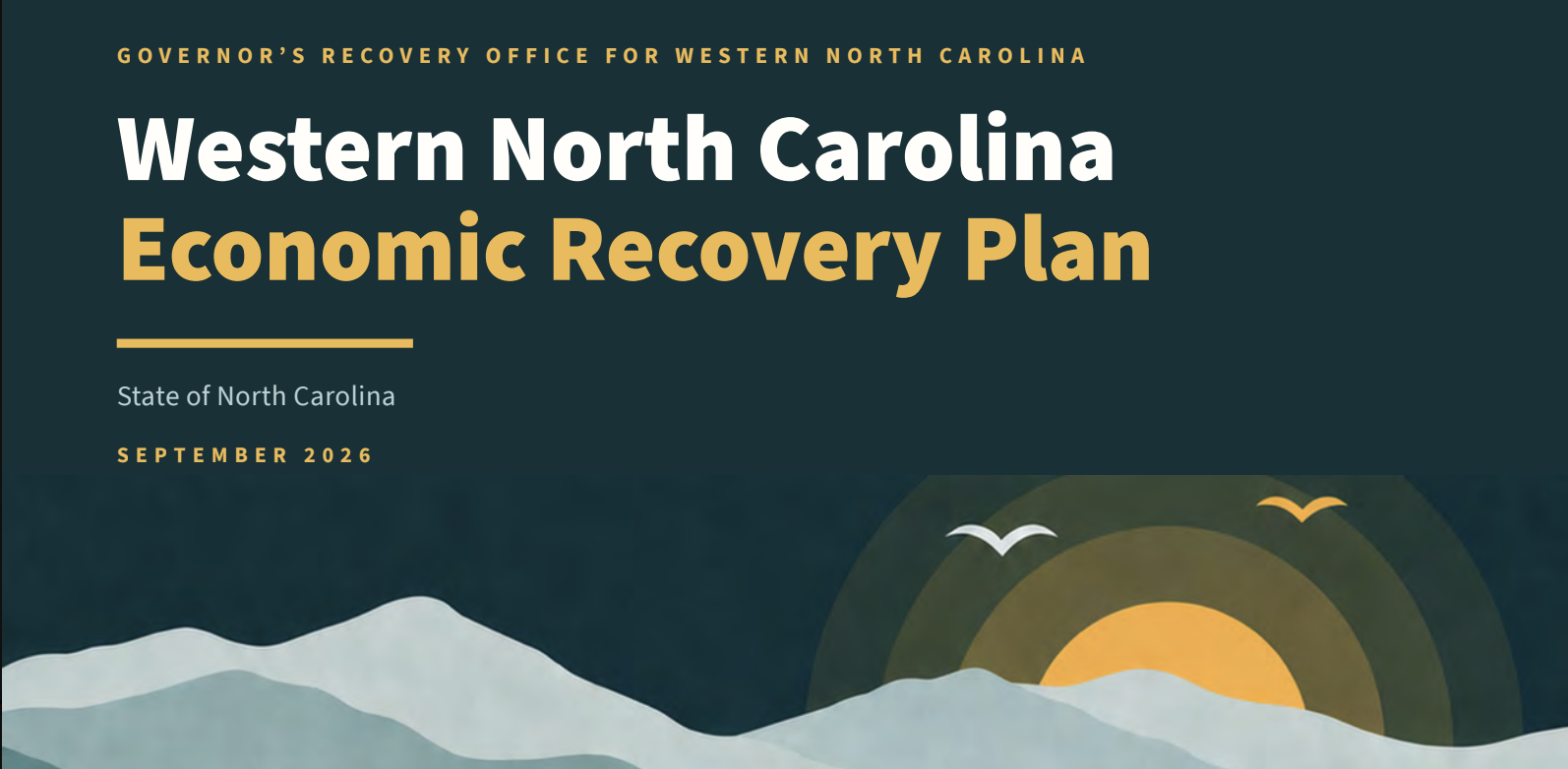
In September 2026, North Carolina released the Western North Carolina Economic Recovery Plan, a framework for the community and economic revitalization of Western North Carolina following Helene. GROW NC is responsible for identifying the specific actions and measures needed to implement it, with actions, targets and timelines expected to be refined as implementation begins.
The plan is clear about what it is—and is not. It is a vision and strategy, not a list of promises or a budget. Some projects are already funded and underway; others will require future federal, state, philanthropic or private investment. Its targets are intended to establish a shared direction for progress rather than bind individual agencies to outcomes they do not control.
For the arts and cultural sector, the plan is significant because arts and culture are woven throughout its vision for Western North Carolina’s economic future.
Why is the plan looking beyond disaster recovery?
The plan places Helene within a much longer economic story. Parts of Western North Carolina have experienced decades of economic disruption, particularly from the decline of textile and furniture manufacturing, followed by the Great Recession, COVID-19 and more recent major plant closures.
According to the plan, regional payroll employment grew just 5.4% over the previous three decades, compared with more than 40% statewide. Manufacturing losses were a major factor: the Helene-affected counties accounted for 14.4% of statewide employment in 2023 but experienced 34% of North Carolina’s manufacturing job losses between 1995 and 2023.
The goal is therefore not simply to restore what existed before Helene, but to support long-term economic revitalization, diversification and resilience.
Where do arts and culture fit?
Arts and culture appear at nearly every level of the plan’s economic strategy.
The Vision: The plan calls for a diverse jobs base that builds on Western North Carolina’s strengths in advanced manufacturing, agriculture, health care, arts, tourism and culture, education, and entrepreneurship.
Core Principle: “Elevate local arts, heritage, and cultural institutions to further their success in WNC and boost the region’s creative and tourism economy.”
Line of Effort: “Arts & Culture – coordinate and champion a resilient creative economy to strengthen cultural infrastructure.”
Catalyst: “Amplification of the creative economy” through the region’s craft, cultural, artistic and natural resources, including support for creative businesses, industries, markets and supply chains.
The goal is not simply to restore what existed before Helene, but to build a more diverse and resilient regional economy.
What does the plan propose for the creative economy?
The plan dedicates a section specifically to the Creative Economy.
Per ArtsAVL’s Creative Economy Snapshot, Western North Carolina’s creative economy generated approximately $3.05 billion in sales and supported 34,796 jobs in 2025.
The plan focuses particularly on two regional strengths: craft and music.
For craft, it notes the severe damage caused by Helene—including an estimated 80% of Asheville’s River Arts District destroyed and impacts to Penland School of Craft, the Southern Highland Craft Guild and the Center for Craft. It also points to Etsy and the Center for Craft’s three-year, $10 million investment in regional craft ecosystems as evidence of WNC’s national significance.
The plan calls for stronger connections among makers, creative businesses, manufacturers and suppliers, education and workforce development.
For music, it identifies 2,546 musicians and singers in the region and highlights the North Carolina Arts Council’s Come Hear NC Music Office and community music-development work in Asheville, Marshall and Lansing. It identifies marketing, business development and access to equipment as important to future industry growth.
How does the plan propose growing the creative economy?
The plan’s stated goal is to “amplify and enrich the creative economy” built on WNC’s cultural heritage and natural landscape, describing it as potentially “one of the highest-leverage, most authentic WNC catalysts available.”
Specific ideas include continued use of community colleges and Small Business Centers to support creative businesses, as well as a region-wide artisan cooperative and e-commerce platform to market WNC creativity nationally and globally.
The plan also points to two larger planning efforts already underway.
The N.C. Department of Commerce, Department of Natural and Cultural Resources and Appalachian Regional Commission are developing a statewide strategic plan for the creative economy, expected in 2027.
At the local level, the plan specifically recognizes the Asheville–Buncombe Arts Recovery Framework, describing its approach of positioning arts and culture as essential economic and community infrastructure connected to economic development, tourism, workforce, public space, infrastructure and long-term regional recovery as “a vision shared in this plan.”
How will progress be measured?
The plan includes an Arts & Culture scorecard with a post-Helene baseline and longer-term targets.
Its baseline identifies the River Arts District as approximately 80% destroyed, along with significant losses in facilities, revenue and infrastructure.
The plan identifies these targets:
Within five years: a craft cooperative operating and creative-sector employment and revenue restored to pre-disaster levels.
Within ten years: a regional creative economy and craft-industry strategy implemented and creative-sector infrastructure restored.
Across the plan and its supporting recommendations, the N.C. Department of Natural and Cultural Resources, North Carolina Arts Council, ArtsAVL, Craft Your Commerce at Mountain Bizworks, arts councils, regional craft centers and other partners are identified as potential leaders and partners in this work.
As the plan itself cautions, these targets are directional measures of progress rather than binding commitments.
How is this work intended to come together?
One of the most important themes of the plan is coordination.
Western North Carolina already has substantial recovery funding, planning capacity, organizations and initiatives at work, including federal and state agencies, local and regional governments, economic development organizations, chambers and philanthropy.
The plan says the challenge is ensuring recovery is “not only robust but unified across all levels” by creating a shared framework that recognizes priorities partners have already established, builds on regional assets and connects those efforts.
For the arts and cultural sector, that distinction matters. Regional coordination should build on and invest in the organizations and partnerships already leading this work—not create parallel or competing systems.
That includes building on the regional recovery and creative economy work already being led by ArtsAVL, the North Carolina Arts Council, local arts councils and other partners across WNC.
What about the additional arts recommendations in Appendix D?
Appendix D includes input on the Core Principles from the Long-Term Economic Recovery Subcommittee of the Governor’s Advisory Committee on WNC Recovery. The 12 members of the subcommittee were asked to identify regional assets, goals, actions and measurable outcomes for the next three, five and ten years.
Within that input, the Tourism, Arts & Culture Subcommittee proposed a particularly ambitious set of arts and cultural recovery goals and policy recommendations. These are subcommittee recommendations included as input to the planning process—not the same as the strategies, targets or commitments contained in the core plan.
Among the ideas proposed were direct stabilization assistance for artists and cultural workers; funding and expansion of a regional arts recovery framework; investment in cultural districts and creative corridors; affordable live/work space and creative workforce programs; long-term disaster preparedness; and making the creative economy a permanent part of regional economic-development planning.
The recommendations also propose that Western North Carolina “Establish WNC as a National Model for Arts-Led Disaster Recovery” by documenting and sharing how arts, culture and tourism can contribute to disaster recovery.
That work is already beginning. ArtsAVL has spent the past two years sharing lessons from Western North Carolina’s recovery with national partners, including presentations at the National Endowment for the Arts’ National Council on the Arts meeting and the Americans for the Arts national conference in 2026.
The subcommittee input also raises questions that will need further discussion. For example, it proposes a dedicated funding pipeline for rural artists outside Buncombe County. While expanding access for rural artists is important, excluding Buncombe County is difficult to reconcile with the broader plan’s emphasis on regional collaboration, particularly given the significant damage sustained by Buncombe County’s arts community.
What happens next?
The Economic Recovery Plan establishes a direction for Western North Carolina, not a finished implementation roadmap.
GROW NC is responsible for identifying the specific actions and measures needed to implement the plan, and actions, targets and timelines will continue to be refined.
For the arts community, the key questions are therefore which strategies move into implementation, how they are funded, who is best positioned to lead them, and how new investment strengthens the organizations and partnerships already doing this work.
The opportunity is not to start over. It is to connect and expand the work already underway across Western North Carolina—and ensure that the creative economy has the resources and infrastructure necessary to contribute fully to the region’s long-term recovery.
What are the big questions?
- How will the plan translate into investment for the creative economy?
- How will state and regional efforts build on existing arts leadership and infrastructure?
- How will artists, creative businesses and arts organizations participate in implementation?
- How will the Asheville–Buncombe Arts Recovery Framework connect with broader regional and statewide work?
- And how will we know when the creative economy has not only recovered, but become stronger and more resilient?
RELATED REPORTS
ArtsAVL Awards $665,000 to 65 Nonprofit Arts Organizations Across Western North Carolina
ArtsAVL awarded $665,000 in recovery grants to 65 nonprofit arts organizations across Western North Carolina impacted by Hurricane Helene.
ArtsAVL Releases Draft Asheville-Buncombe Arts Recovery Framework for Public Review
ArtsAVL has released the draft Asheville-Buncombe Arts Recovery Framework for public review. Read the report and share feedback through June 15.
Asheville Recovers Together Announces $14.6M Small Business Grant Program for Helene-Impacted Businesses
Eligible Asheville small businesses impacted by Hurricane Helene can apply for grants from $5,000 to $75,000 through Asheville Recovers Together.