
ArtsAVL Releases 2026 Creative Economy Snapshots for 28 Western North Carolina Counties
Second year of expanded regional reporting provides new data on Western North Carolina’s creative economy
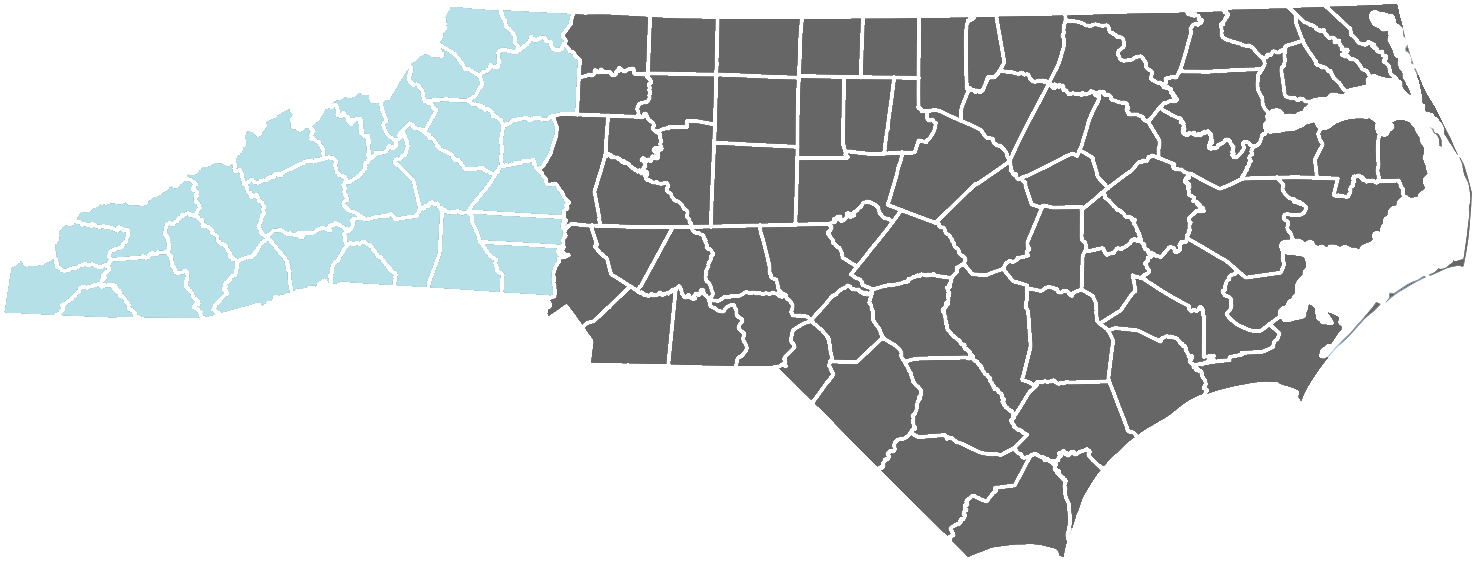
ASHEVILLE, NC (August 2026) —ArtsAVL has released its latest Creative Economy Snapshot Reports, providing new data on the economic impact, employment, and composition of the creative sector across the 28 westernmost counties of North Carolina.
ArtsAVL has produced Creative Economy Snapshot reports for Buncombe County, and other Western North Carolina communities for a number of years. Following Hurricane Helene, ArtsAVL expanded the project to encompass all 28 westernmost counties as part of its role as the lead point organization coordinating arts recovery efforts across the region. The expanded research established a consistent regional baseline for understanding the storm’s impact on the creative sector and tracking recovery over time.
The 2026 reports examine 2025 data from 56 creative industries and 66 creative occupations and include an individual snapshot for each of the 28 counties as well as a regional analysis. With two years of comprehensive regional data now available, this year’s reports provide the first opportunity to begin identifying changes in Western North Carolina’s creative economy following the storm.
Across the 28-county region, the creative workforce supported 34,796 jobs in 2025, an increase of 1.3% from 2024. At the same time, creative industries generated approximately $3.05 billion in sales, a 2.6% decrease, while GRP earnings declined 1.8% to approximately $1.07 billion.
The findings reinforce other recent ArtsAVL research showing that the region’s creative sector is recovering, but that recovery remains uneven. A one-year follow-up survey of 97 arts businesses that received ArtsAVL Arts Business Relief Grants found that 87.6% had fully reopened, yet 56% were still reporting revenues below pre-Helene levels, including 26% whose revenues remained at least 25% below pre-storm levels.
“When Hurricane Helene hit, we knew that understanding the full impact on the arts would require looking beyond any one community,” said Katie Cornell, Executive Director of ArtsAVL. “Expanding this research to all 28 counties gave us a regional baseline at a critical moment. Now, with a second year of data, we can begin to see how the creative economy is changing and where recovery is happening differently across Western North Carolina. That information is essential to making sure recovery resources and long-term investments respond to what communities actually need.”
The regional figures underscore the complexity of that recovery. Creative employment increased even as overall sales and earnings declined, while individual counties experienced considerably different changes. The county-level reports allow communities to see those differences and better understand the industries, occupations, and creative assets shaping their local economies.
“One of the strengths of this work is that it captures both the scale and the diversity of Western North Carolina’s creative economy,” said Heidi Reiber, Senior Director of Research at the Asheville Area Chamber of Commerce’s Riverbird Research]. “These reports help make that economic activity visible. They also show the distinctive creative strengths within communities and how creative work is woven across the region.”
The reports also demonstrate the diversity of Western North Carolina’s creative economy. The region’s largest creative occupations in 2025 included photographers; musicians and singers; writers and authors; graphic designers; and meeting, convention, and event planners. Creative industries span independent artists and performing arts organizations as well as publishing, design, cultural institutions, commercial printing, furniture, glass, and other forms of creative manufacturing.
This year’s reports place additional emphasis on craft, one of Western North Carolina’s defining creative strengths. County-level data demonstrates the breadth of the region’s craft economy, including activity in glass, clay and ceramics, wood and furniture, textiles and fiber, jewelry, metalwork, printing, musical instruments, and other forms of skilled production.
Each county report also provides local context surrounding Hurricane Helene, recognizing that the storm affected communities differently. Together, the reports provide local governments, arts organizations, economic development partners, funders, and community leaders with data to inform ongoing recovery efforts and future investment in the region’s creative sector.
Creative economy data was provided by Riverbird Research using Lightcast 2026.2 data, with analysis, interpretation, and report development by ArtsAVL. The project was supported by the Land of Sky Regional Council, the Appalachian Regional Commission, and Dogwood Health Trust, with input from WNC Arts partners across Western North Carolina.
The 2026 Western North Carolina Creative Economy Snapshot Reports are available at: wncarts.org/impact
ALEXANDER
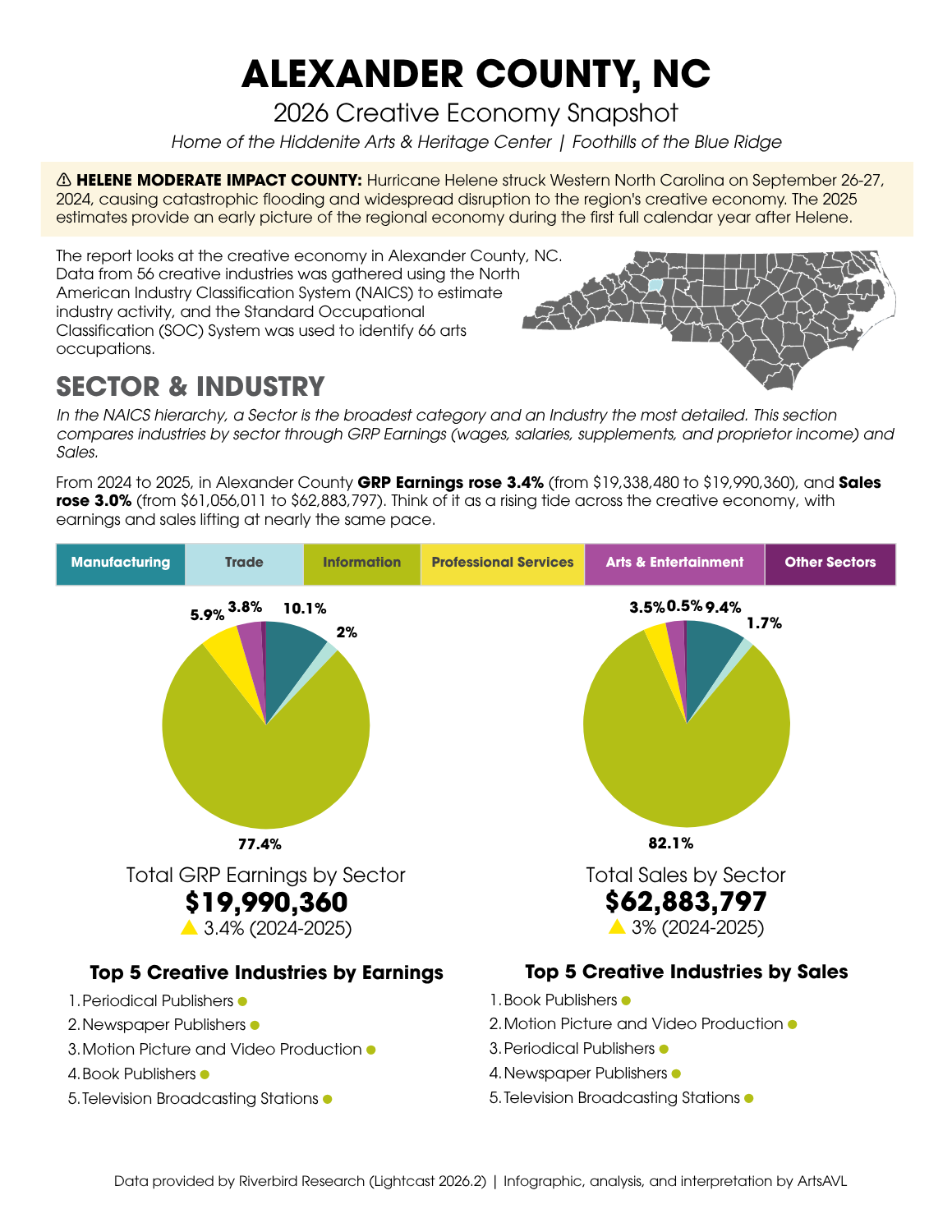
ALLEGHANY
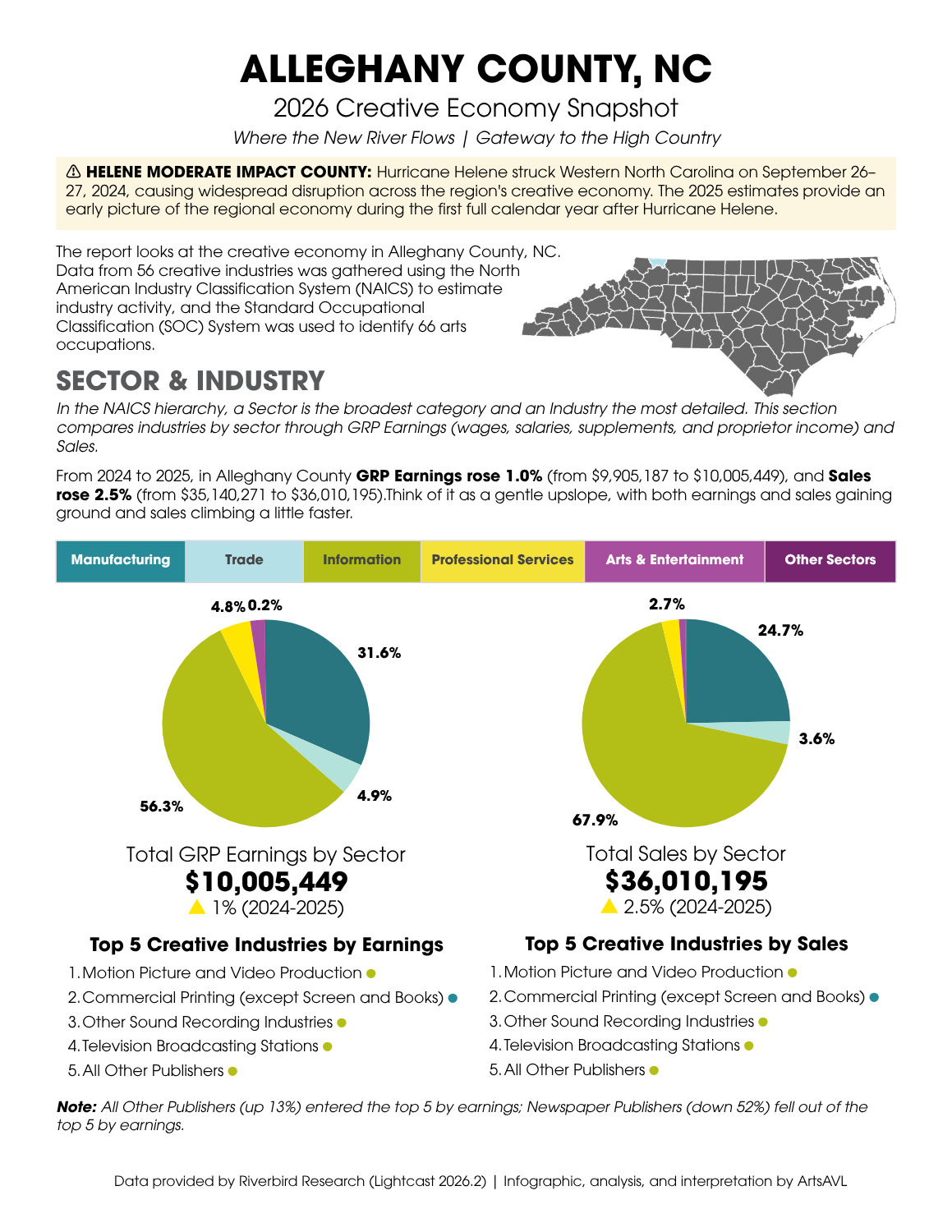
ASHE
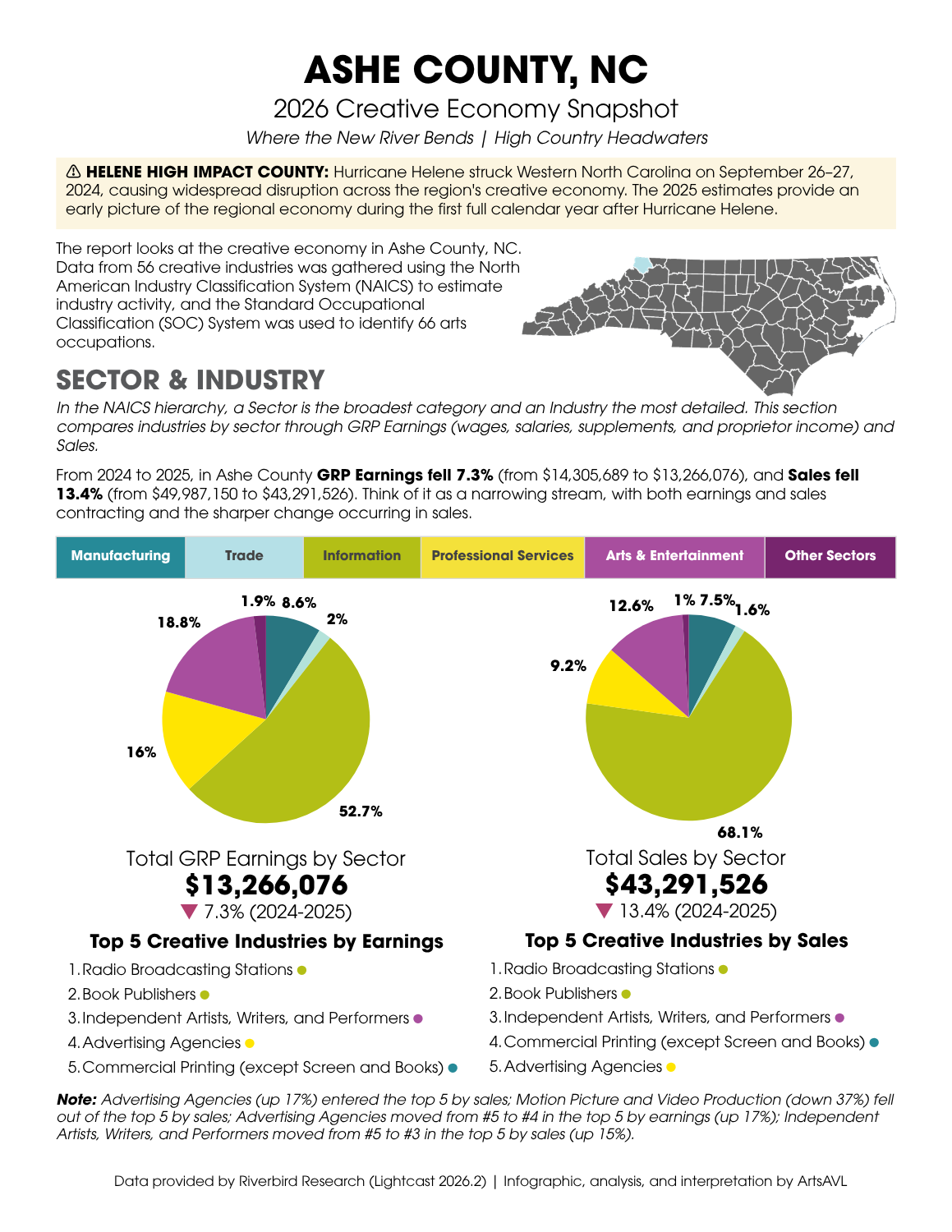
AVERY
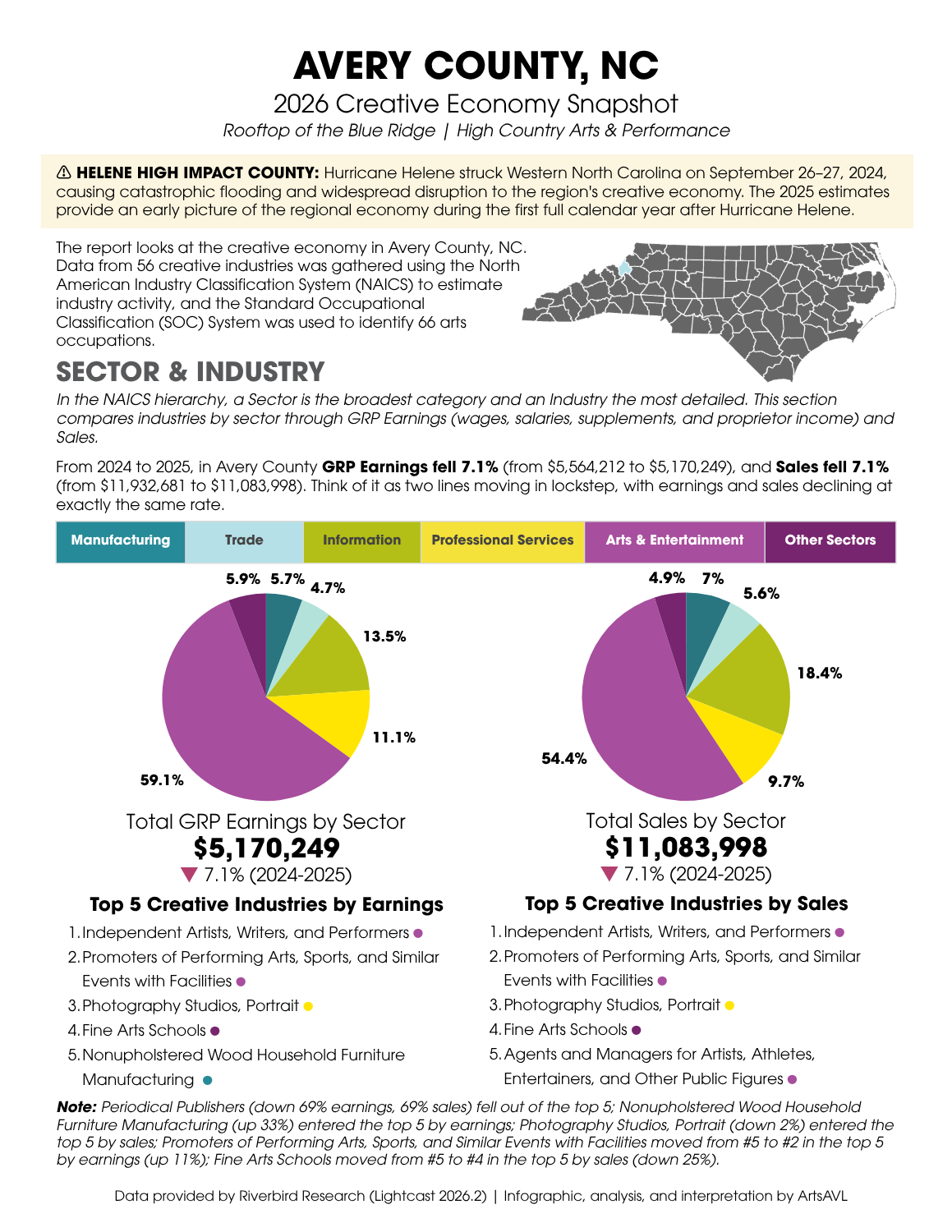
BUNCOMBE
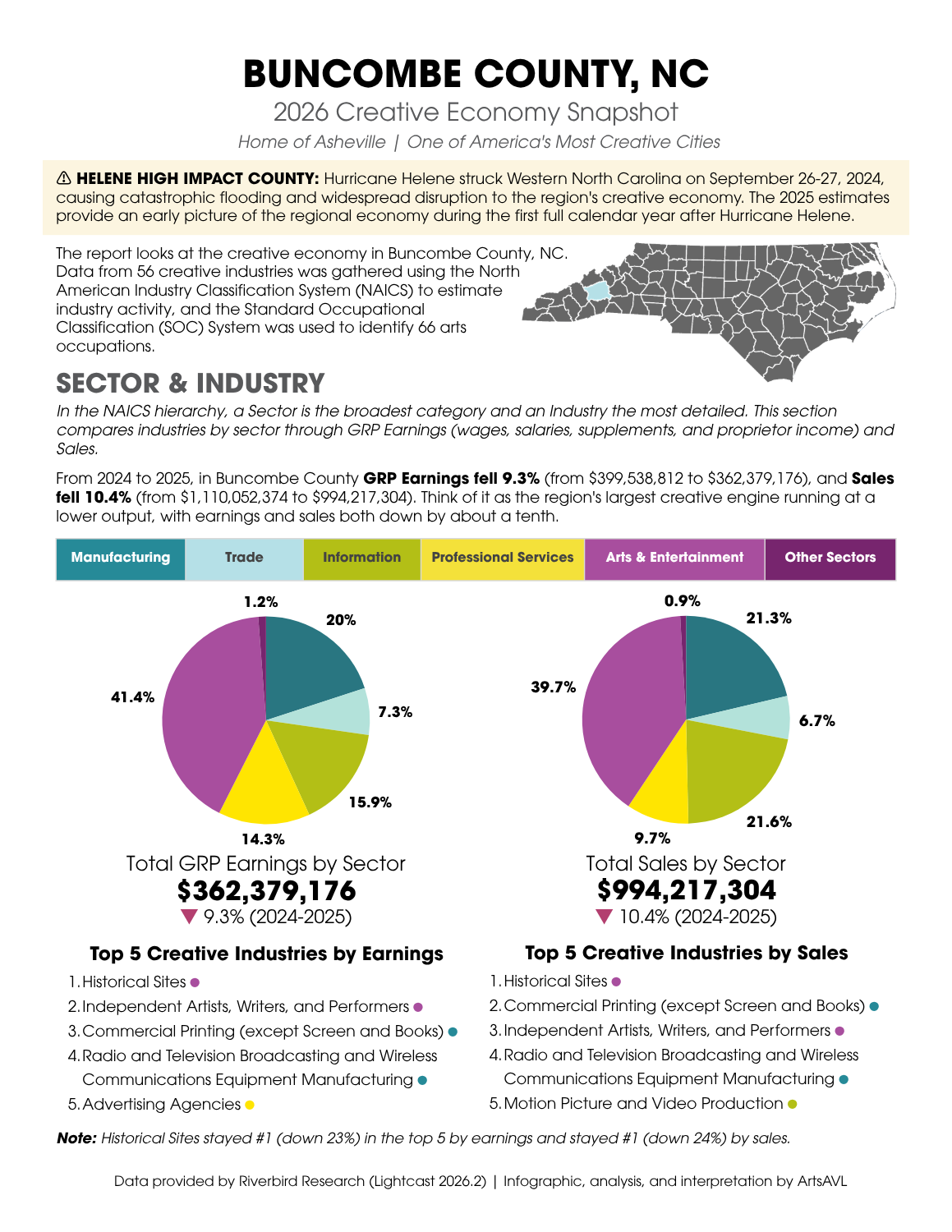
BURKE
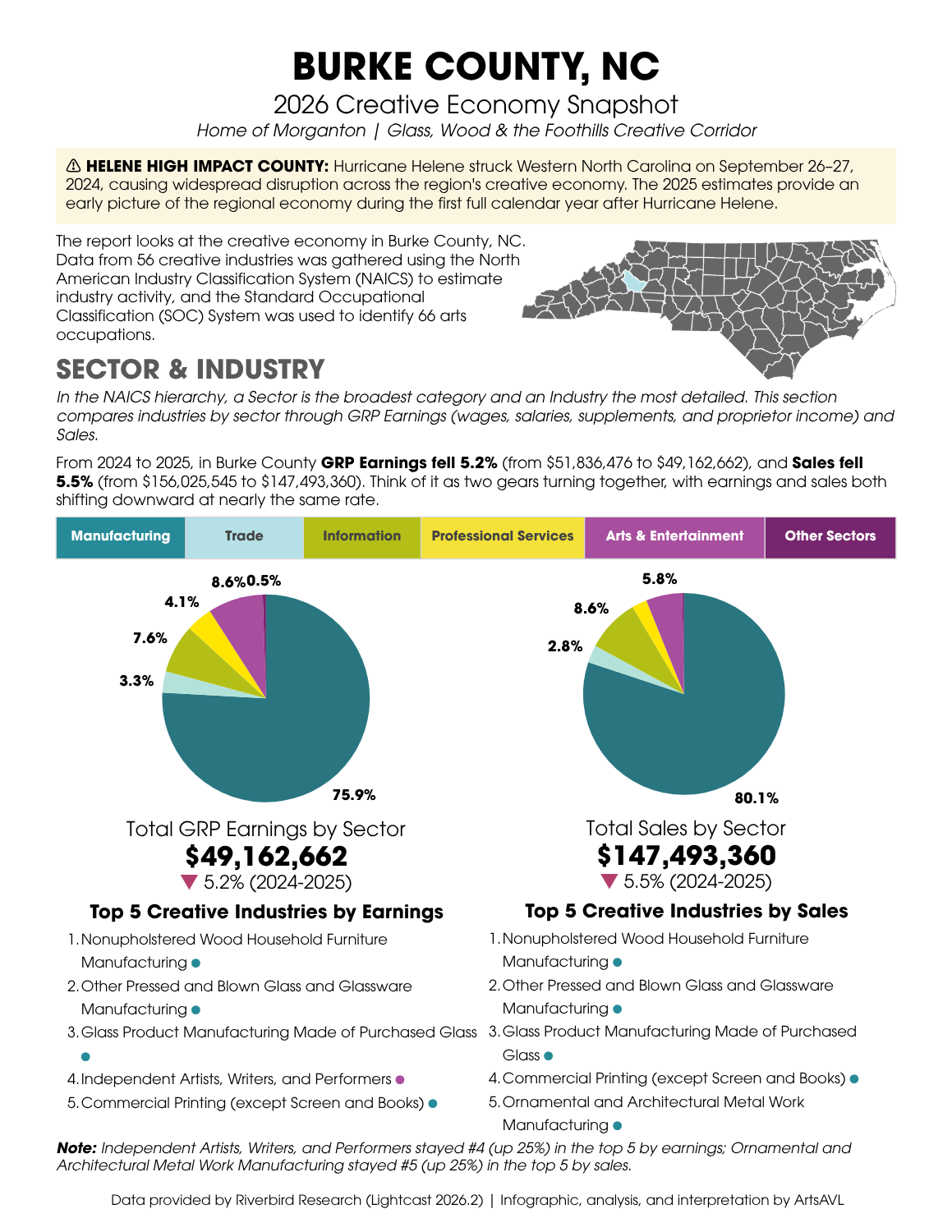
CALDWELL
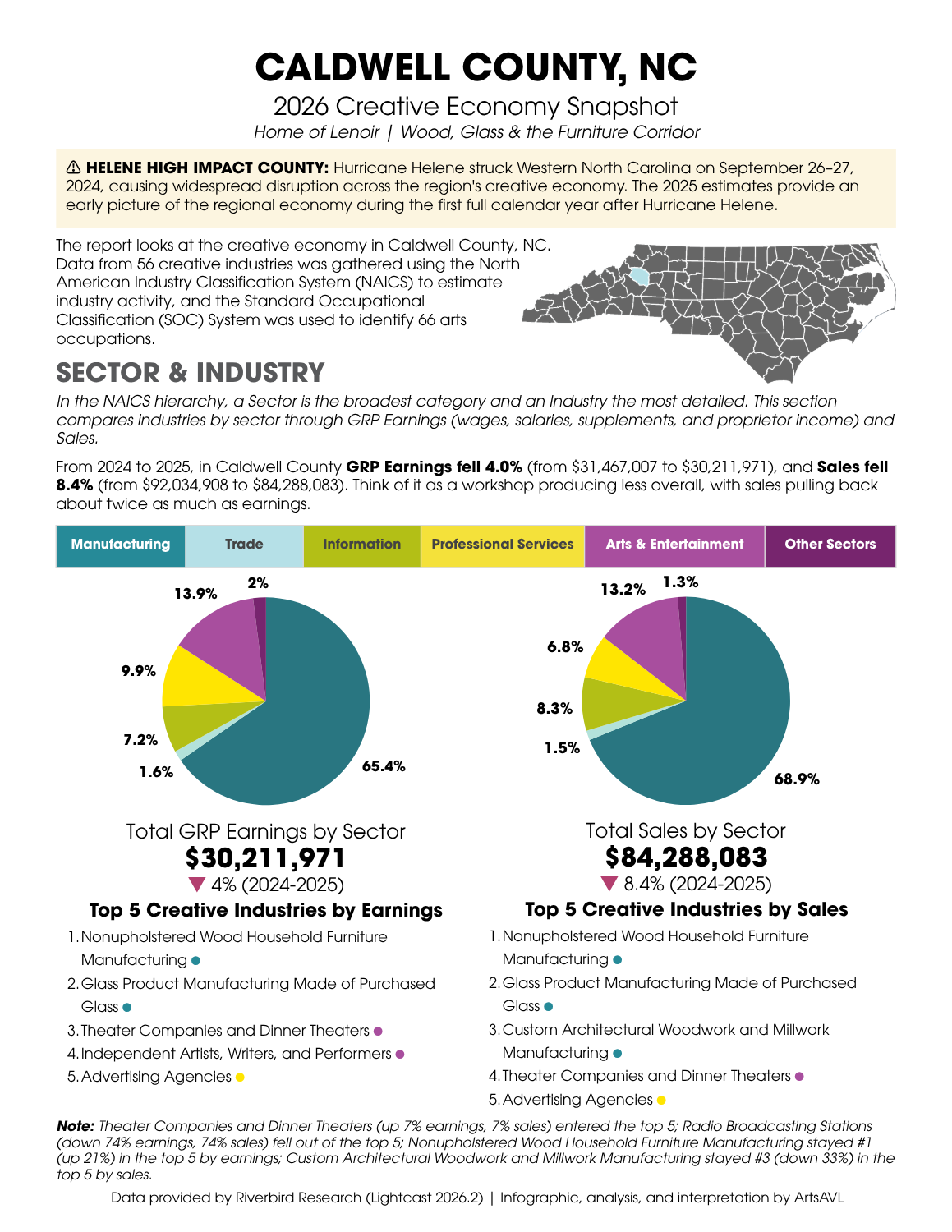
CATAWBA
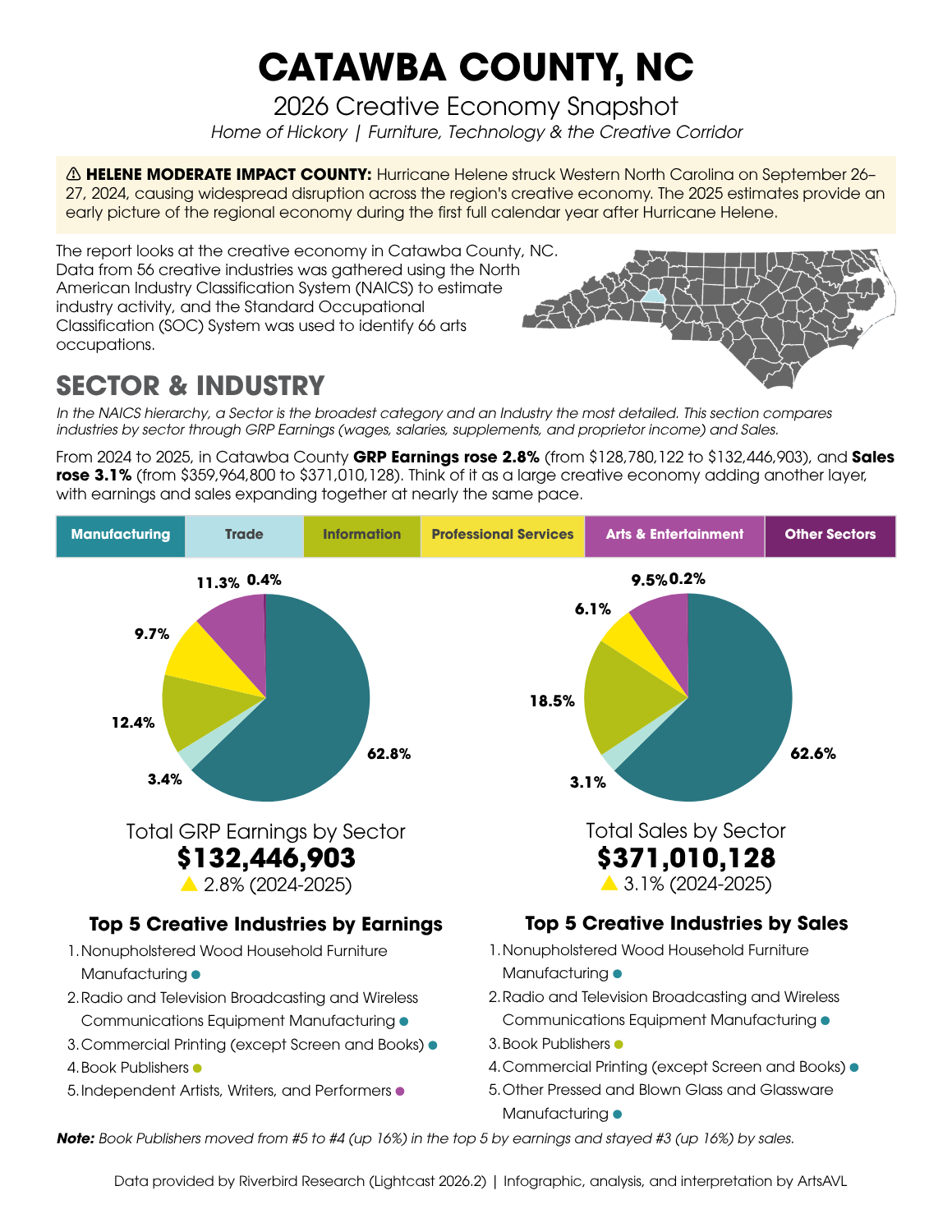
CHEROKEE
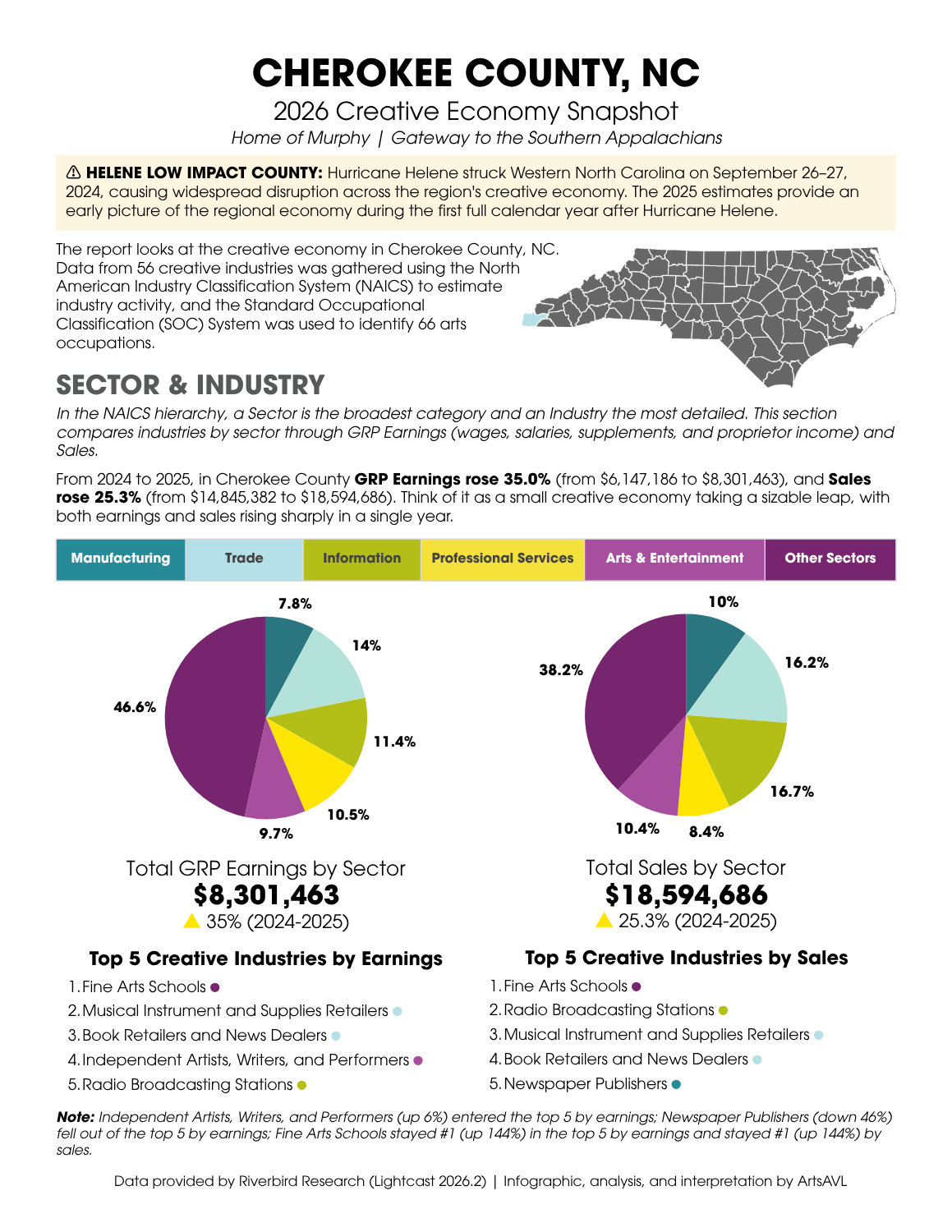
CLAY
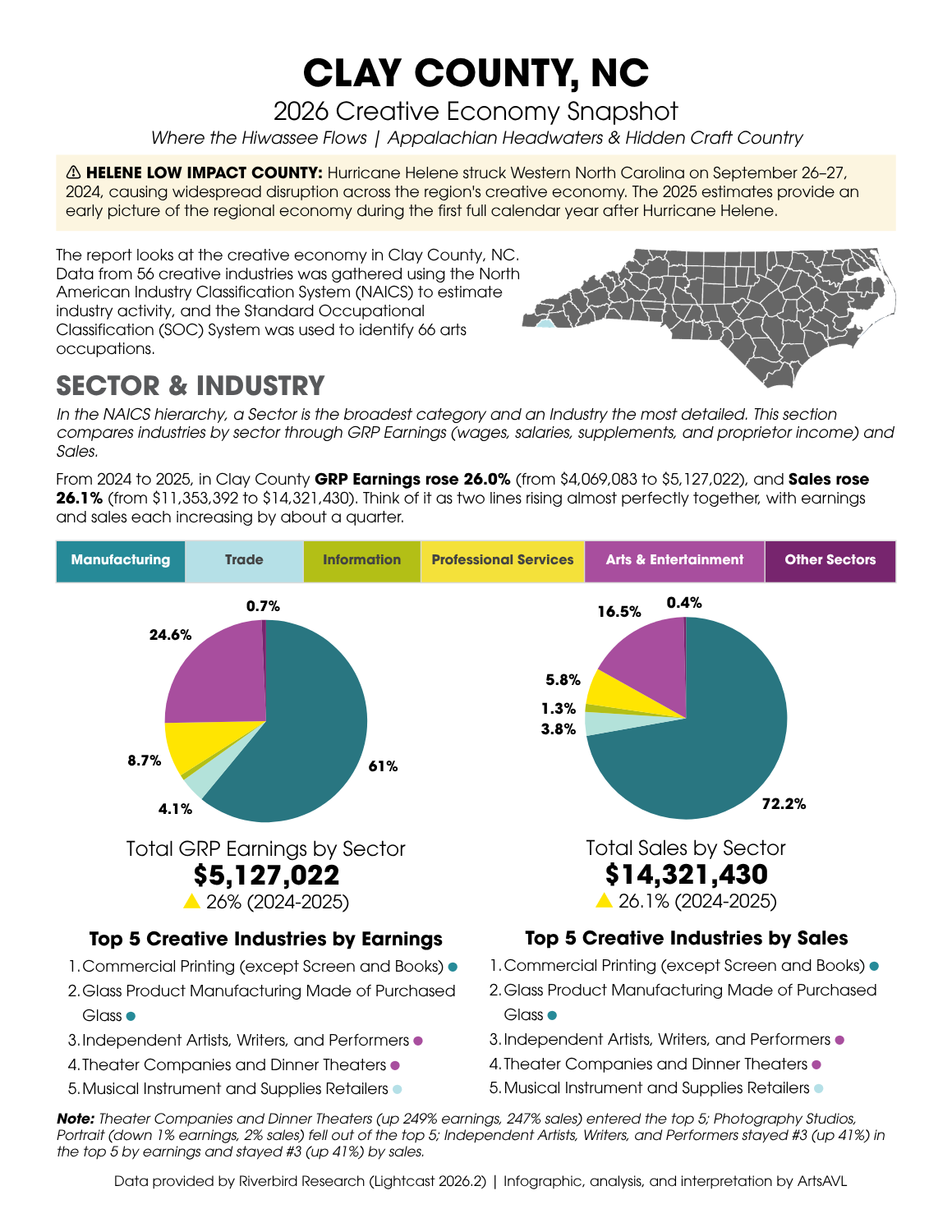
CLEVELAND
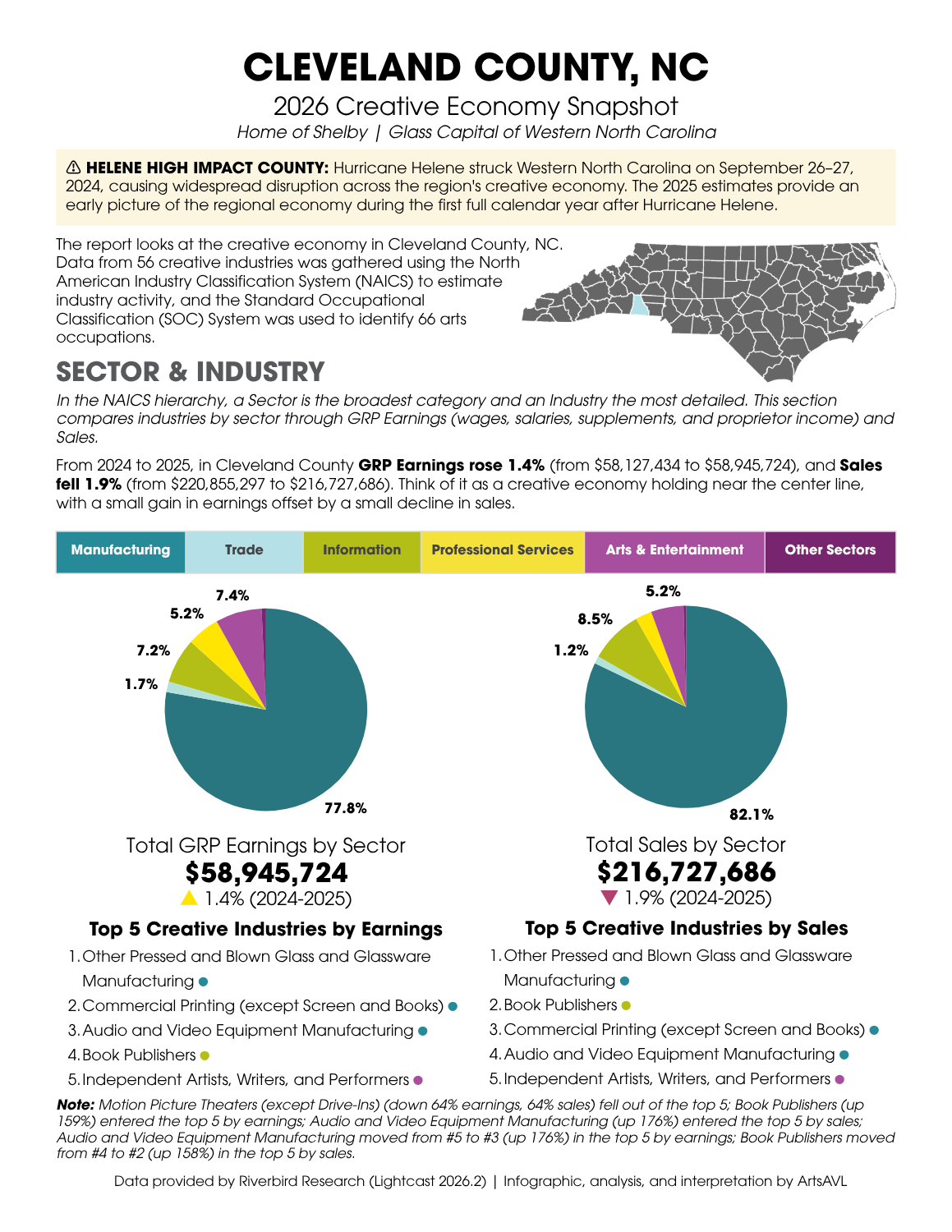
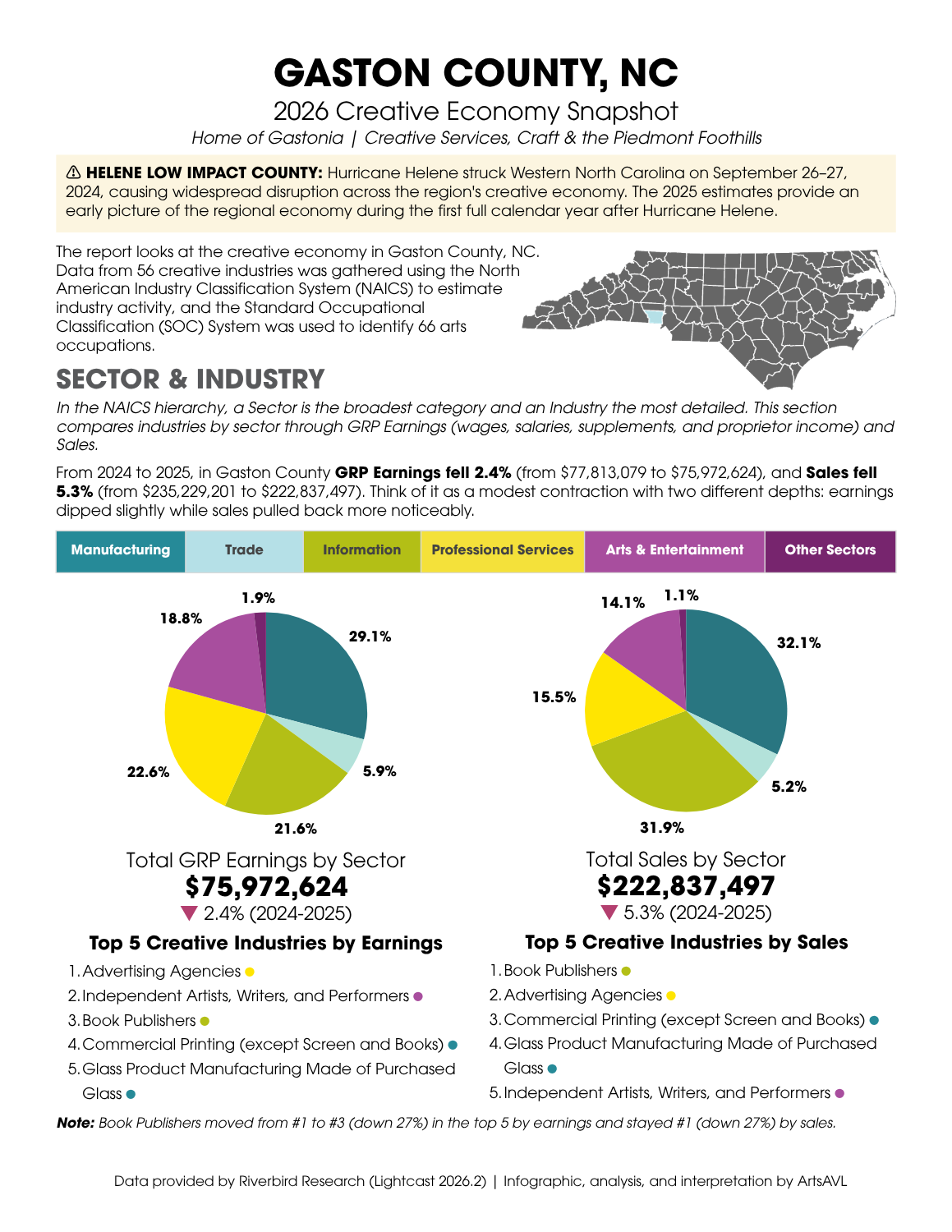
GASTON
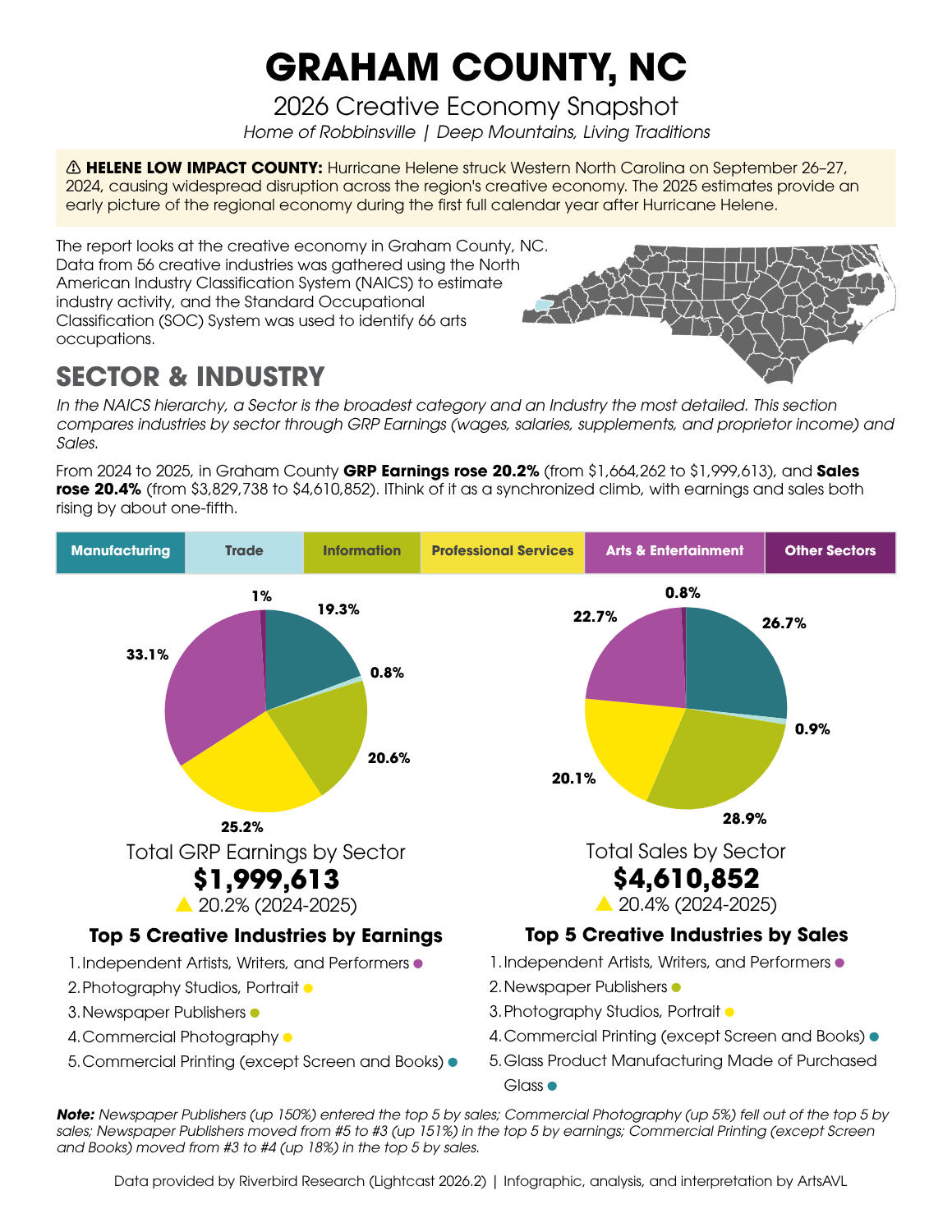
GRAHAM
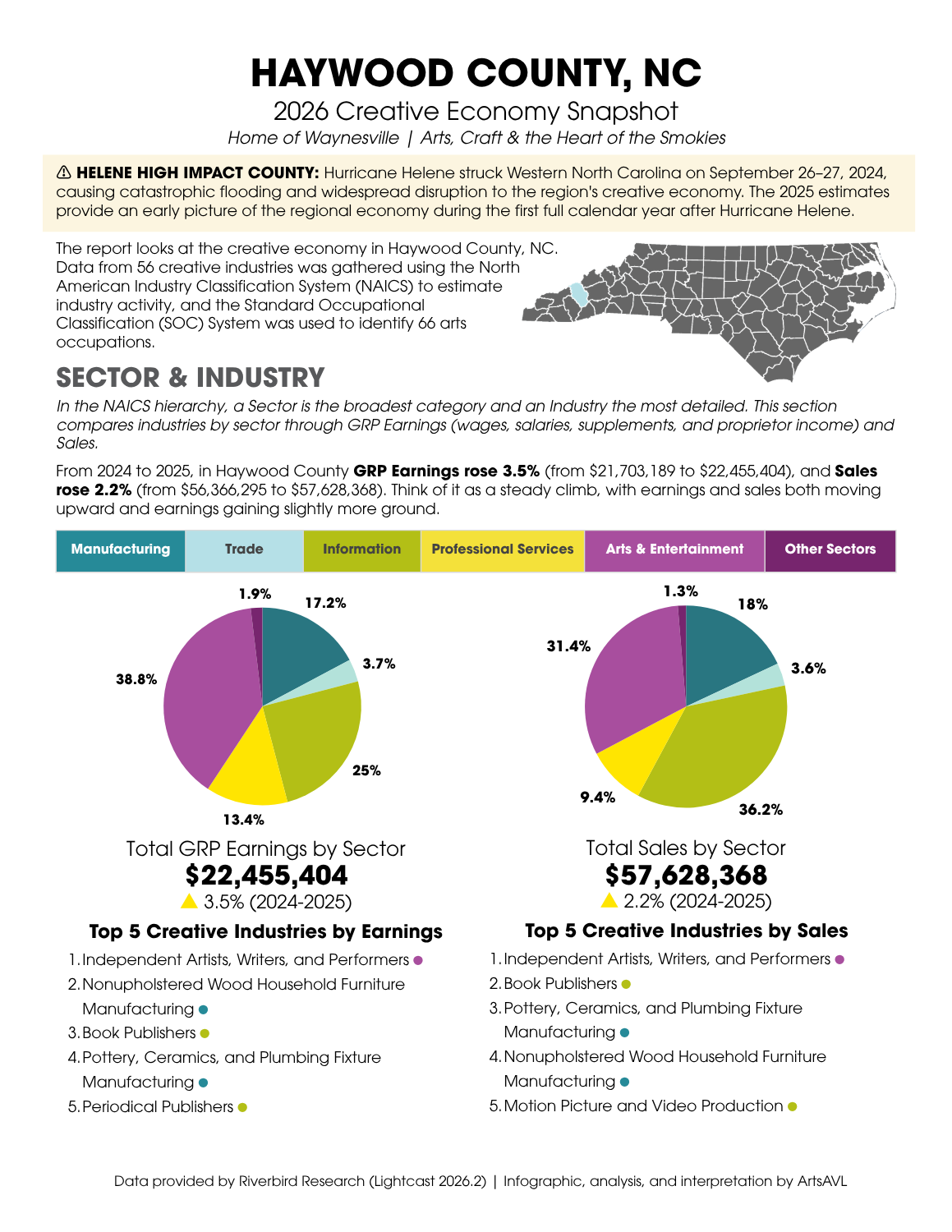
HAYWOOD
HENDERSON
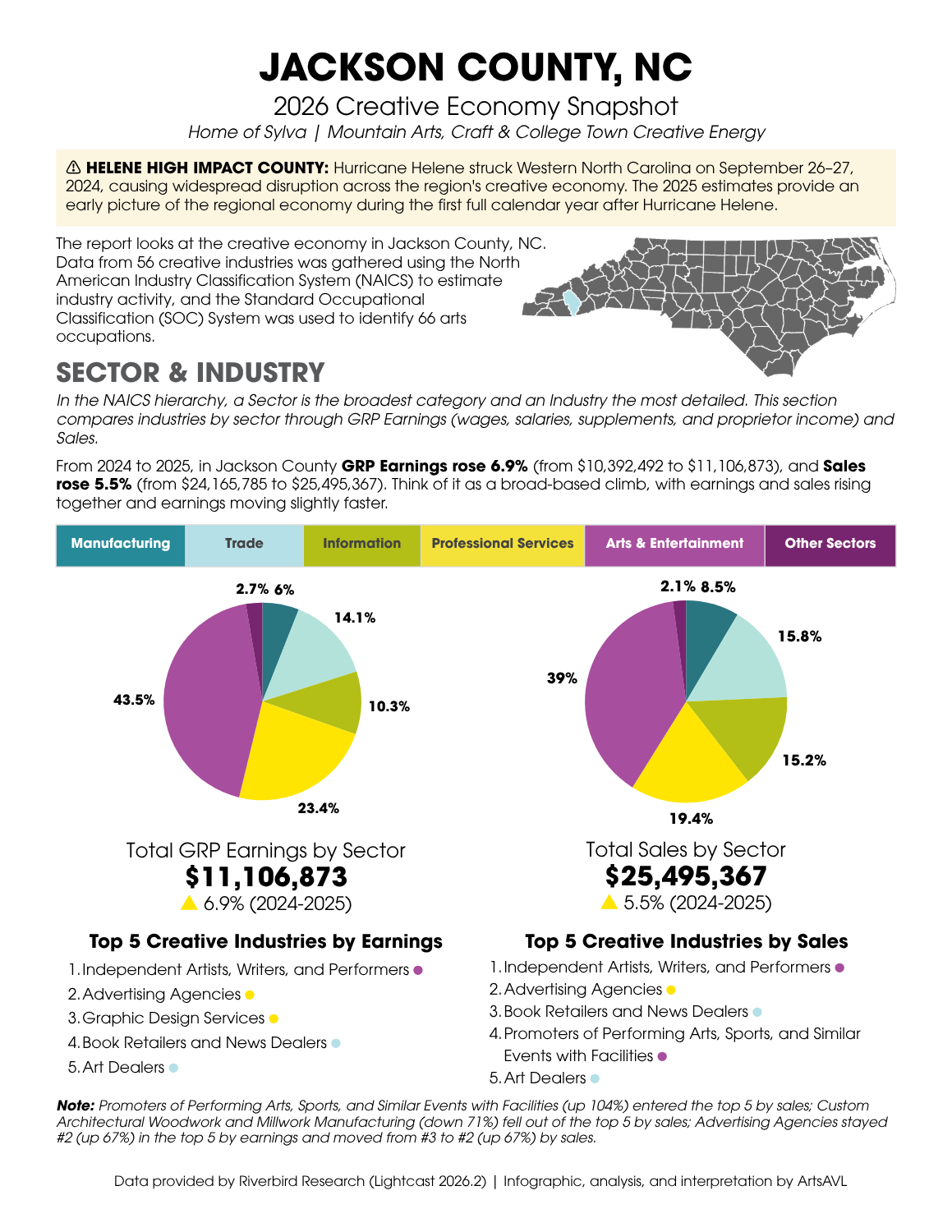
JACKSON
LINCOLN
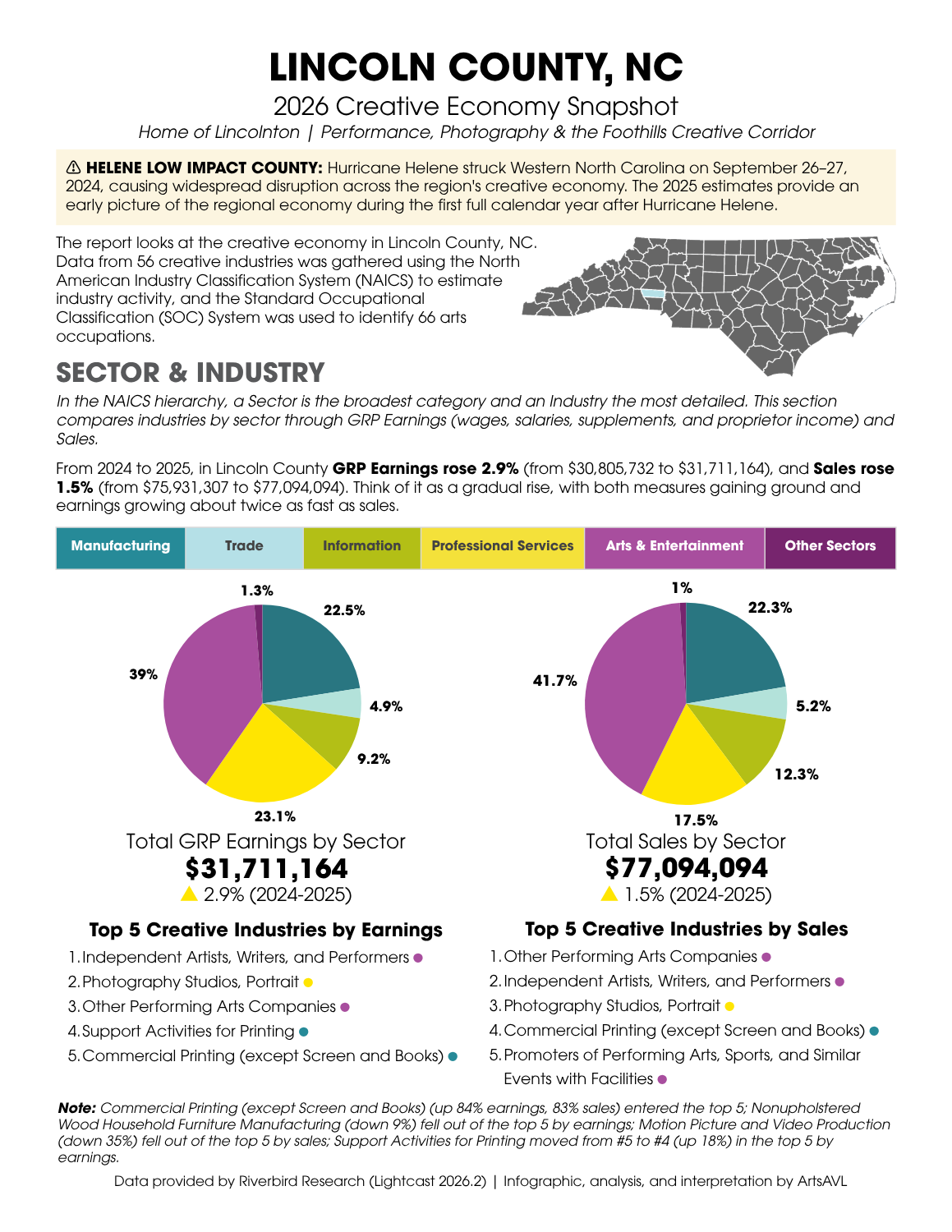
MACON
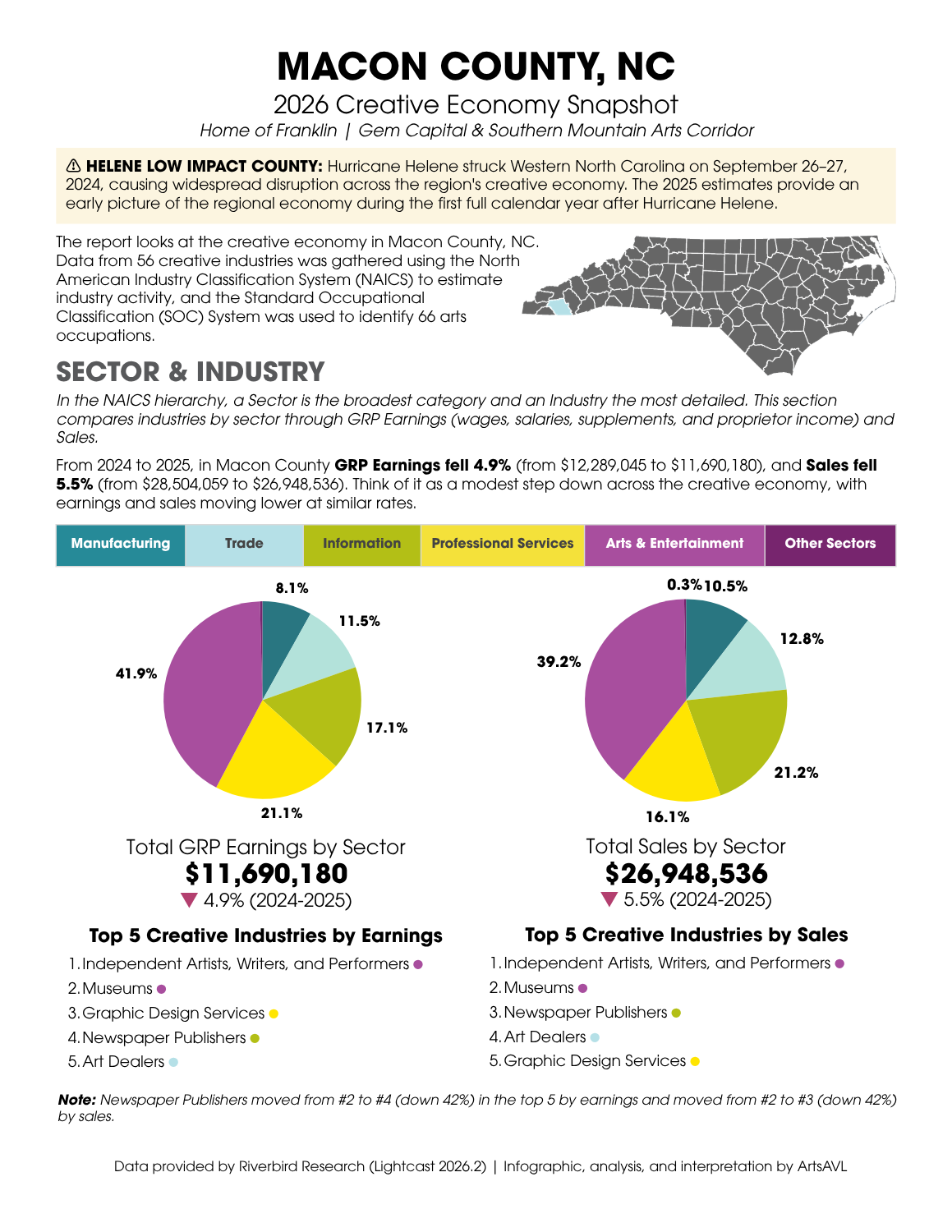
MADISON
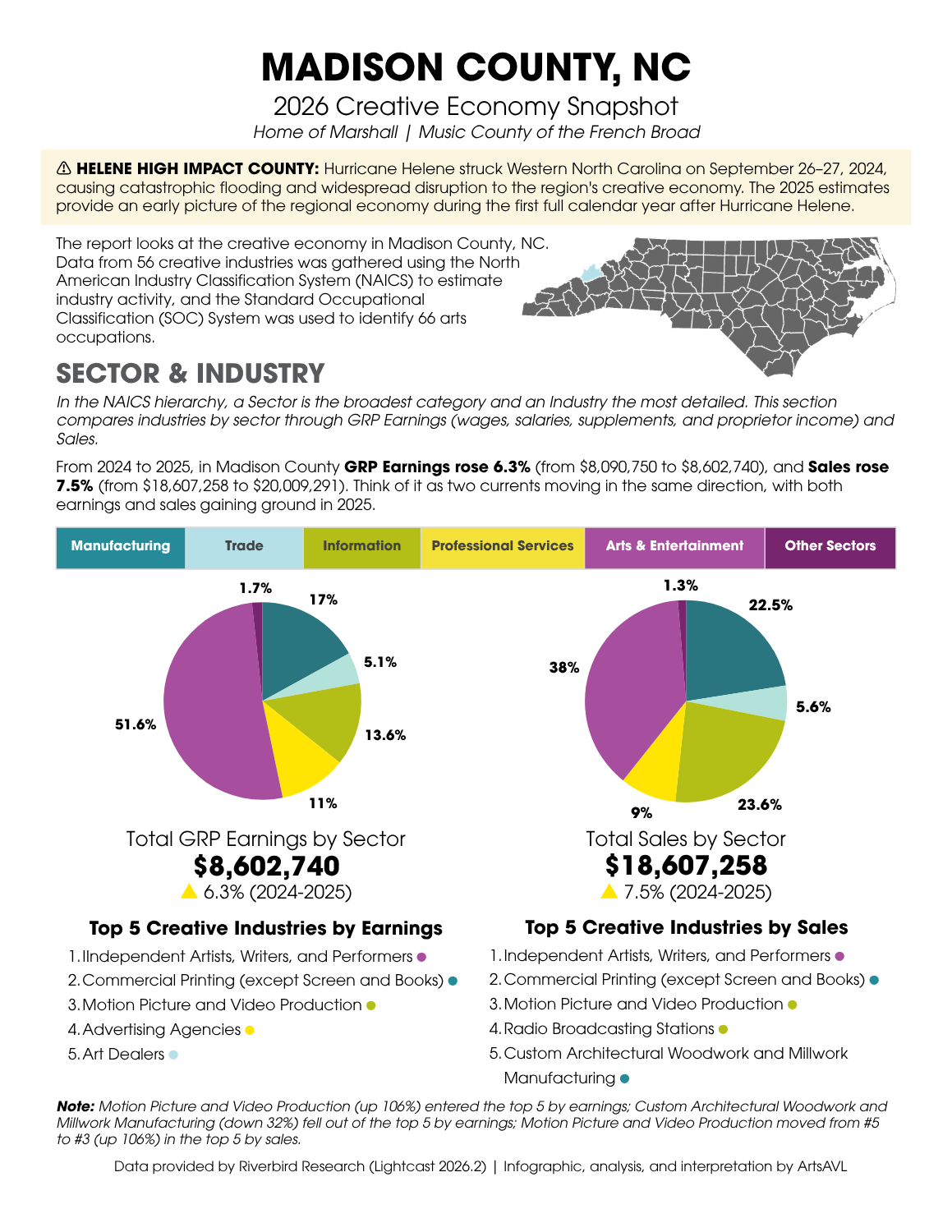
McDOWELL
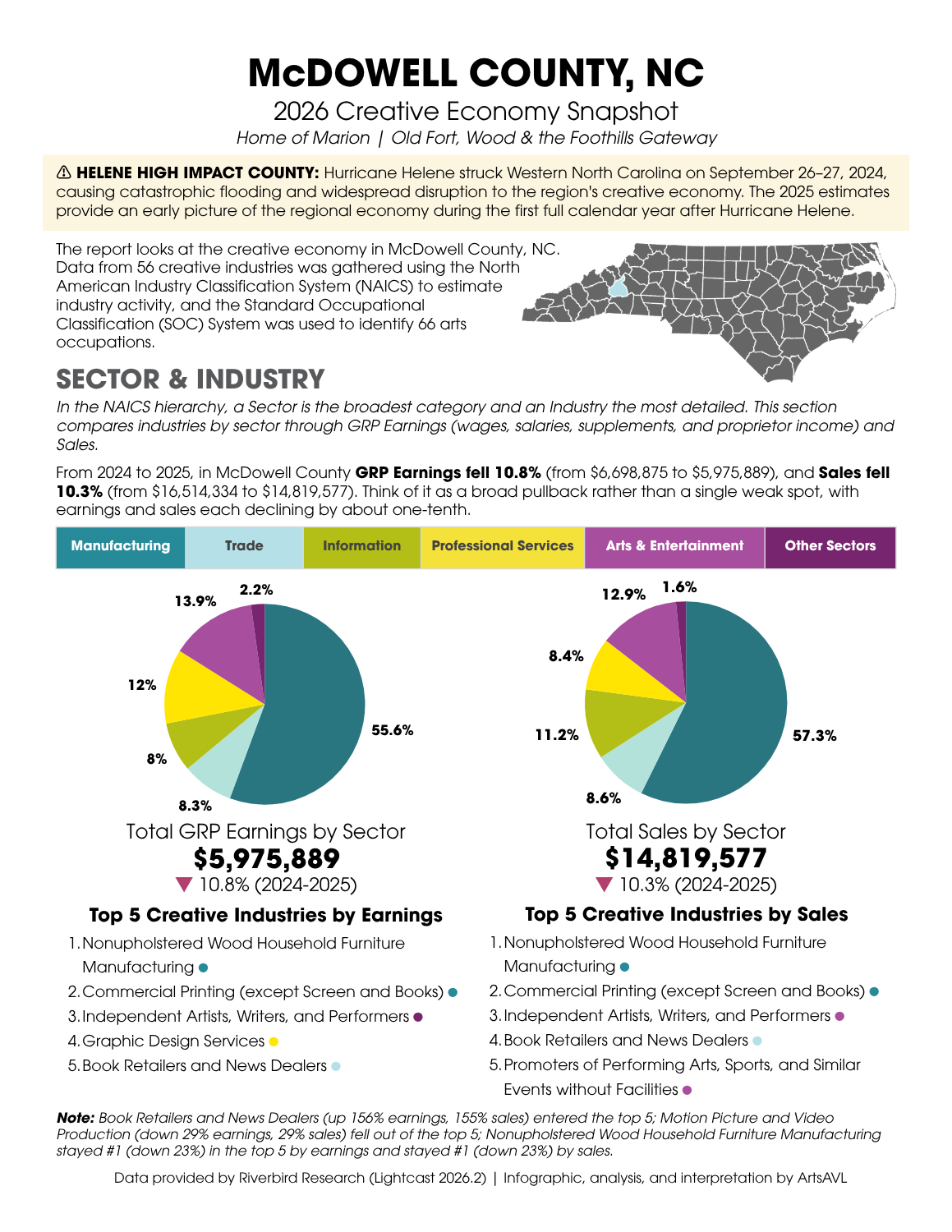
MITCHELL
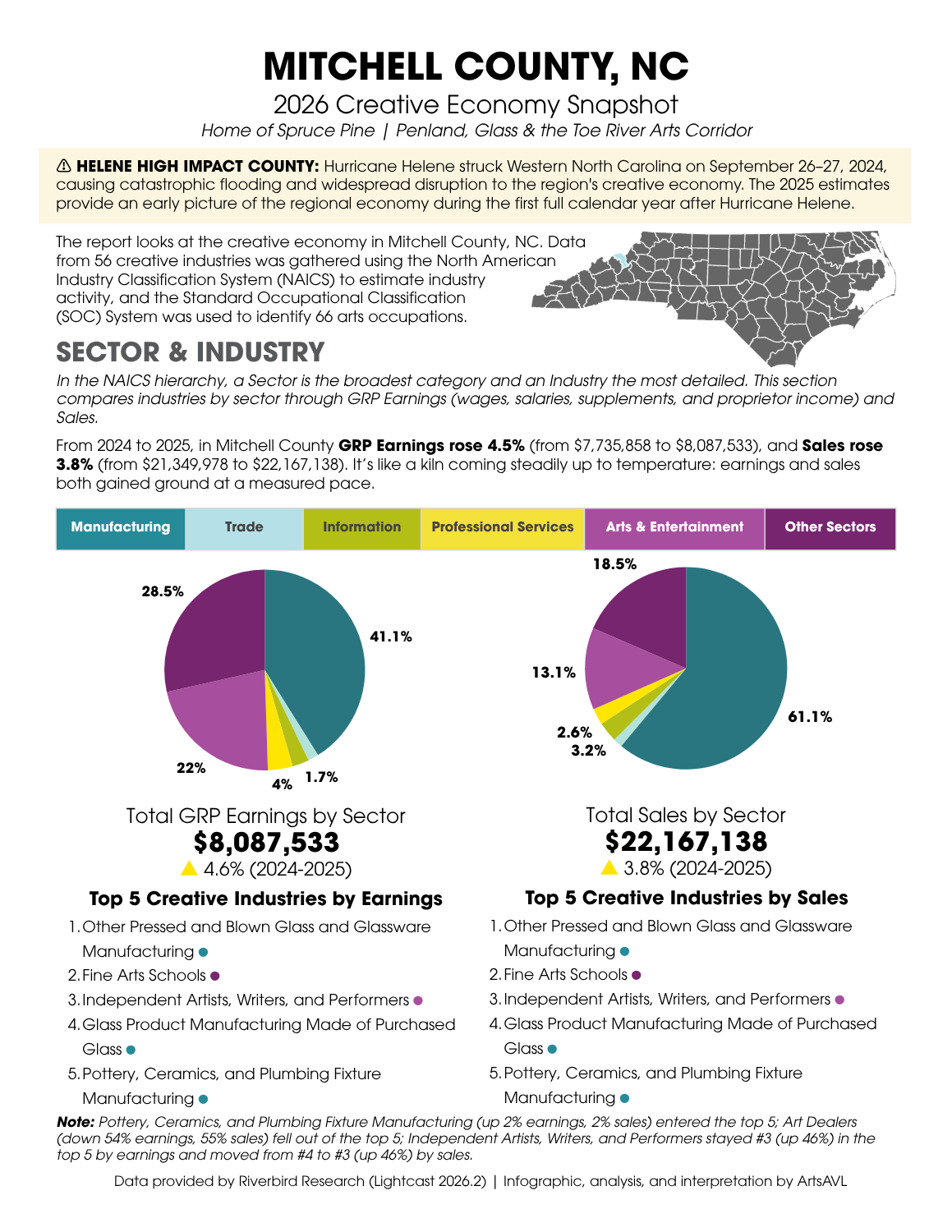
POLK
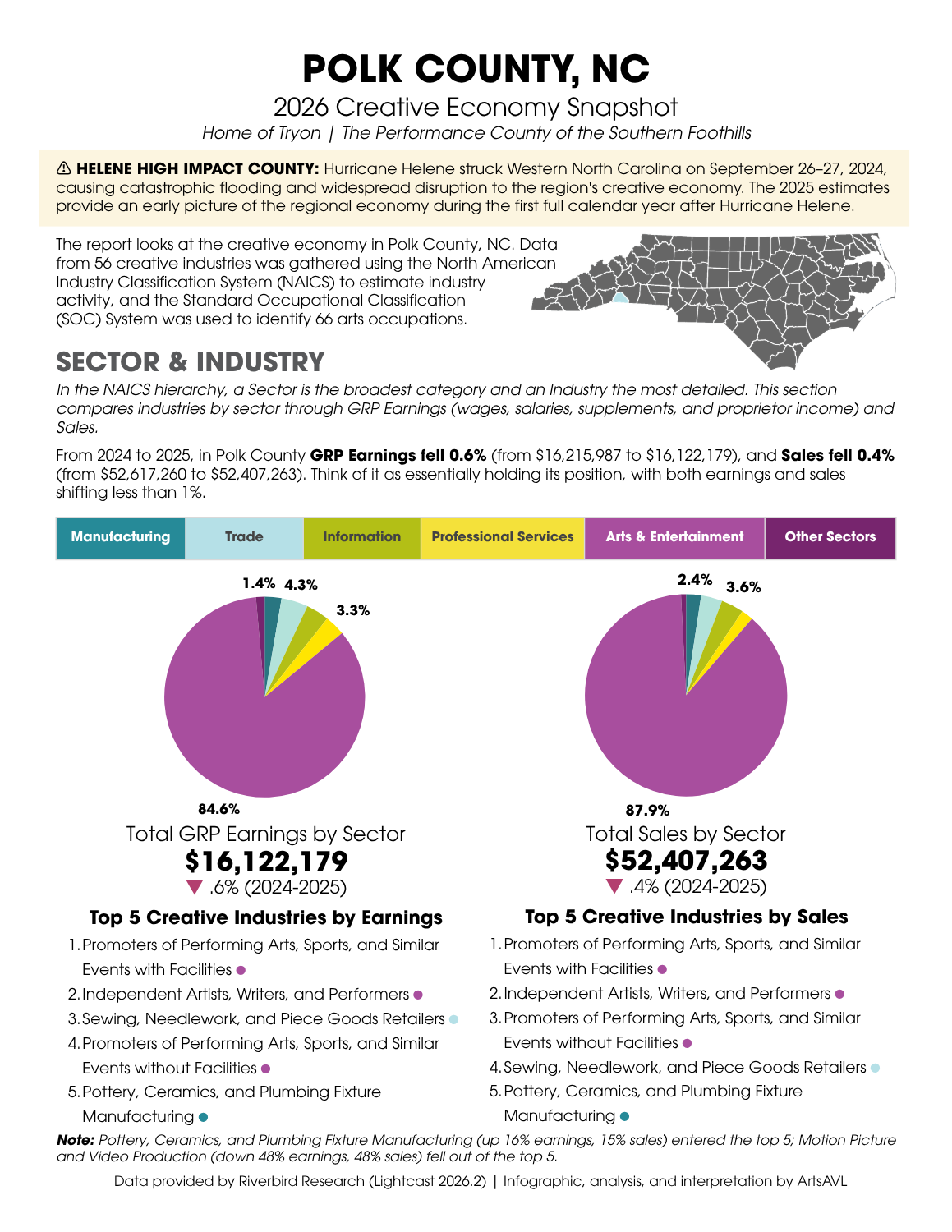
RUTHERFORD
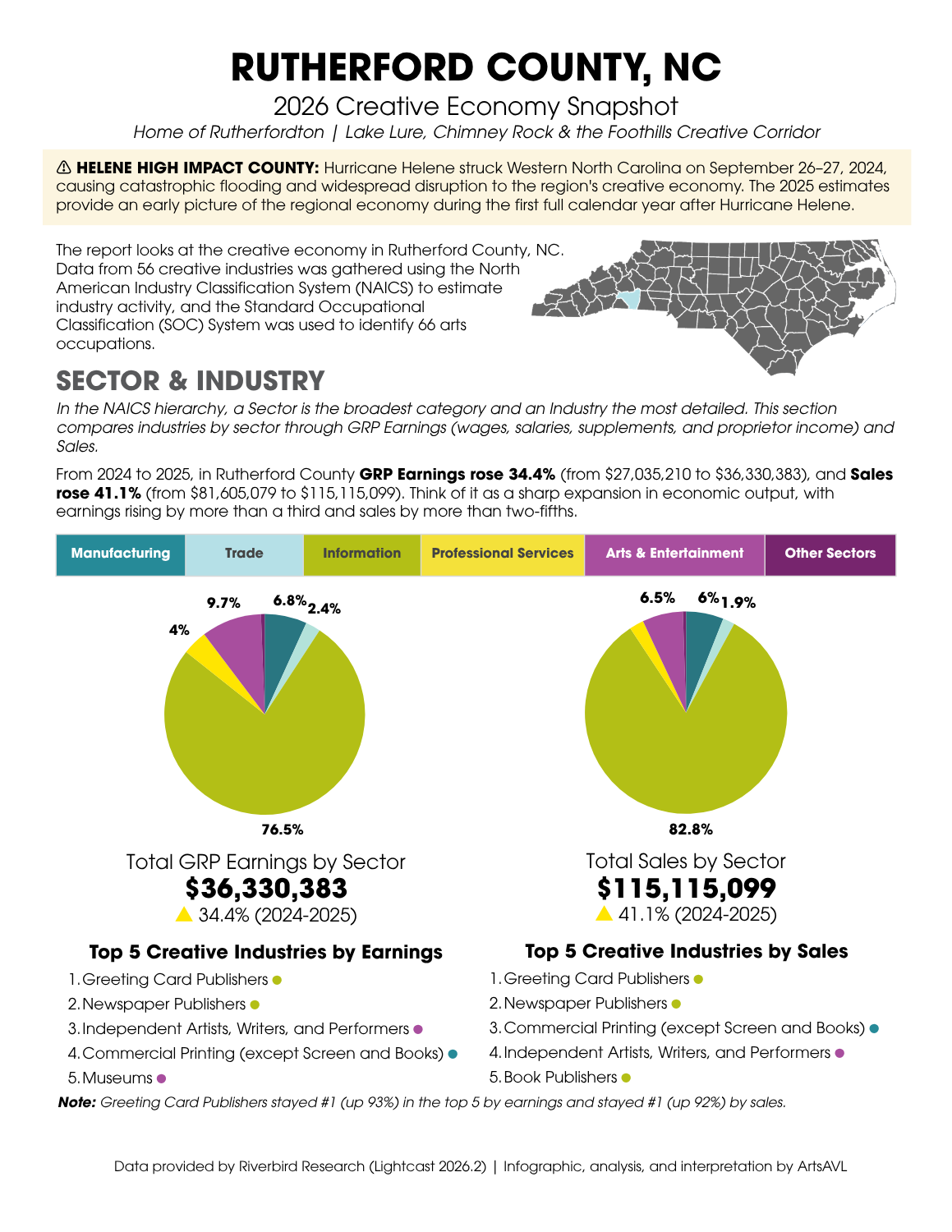
SWAIN
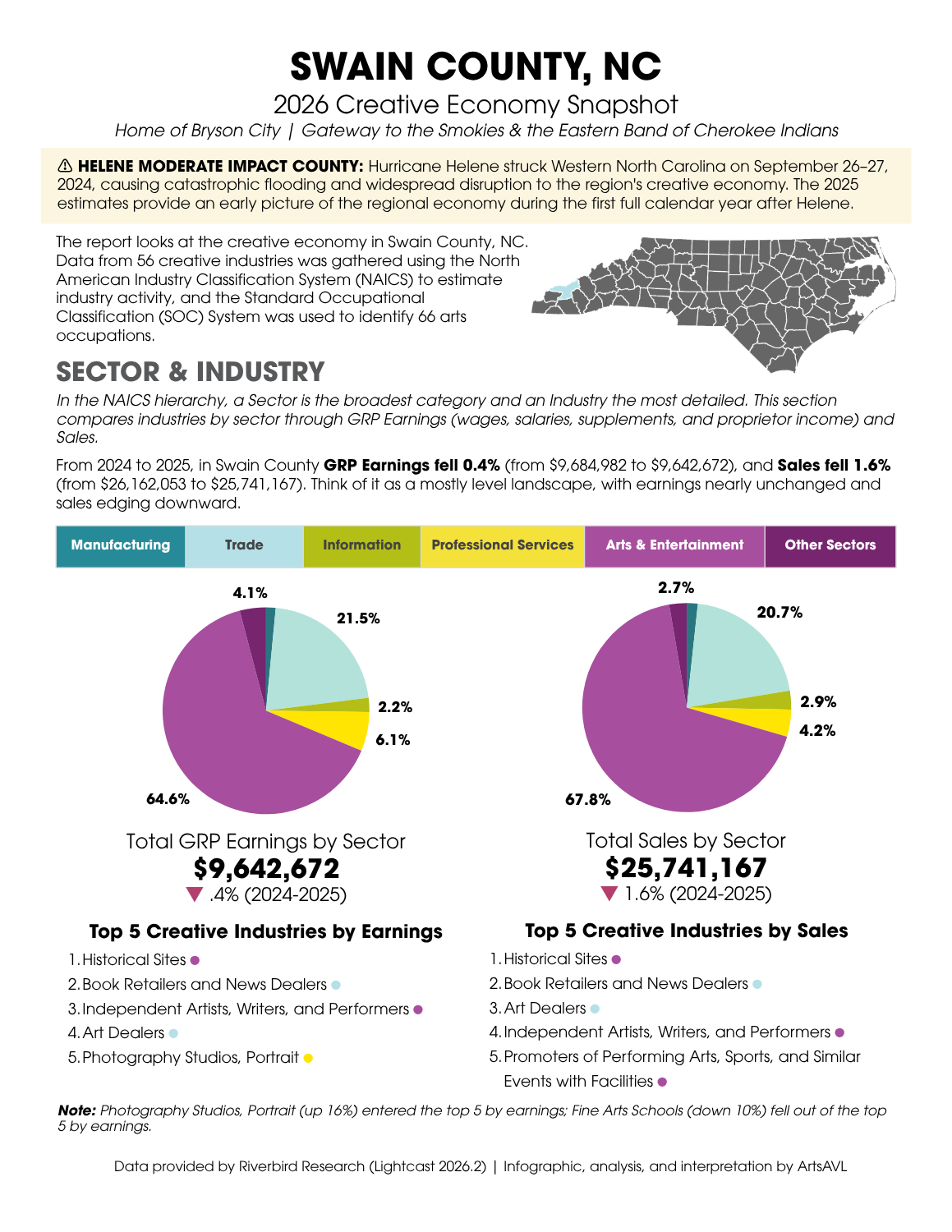
TRANSYLVANIA
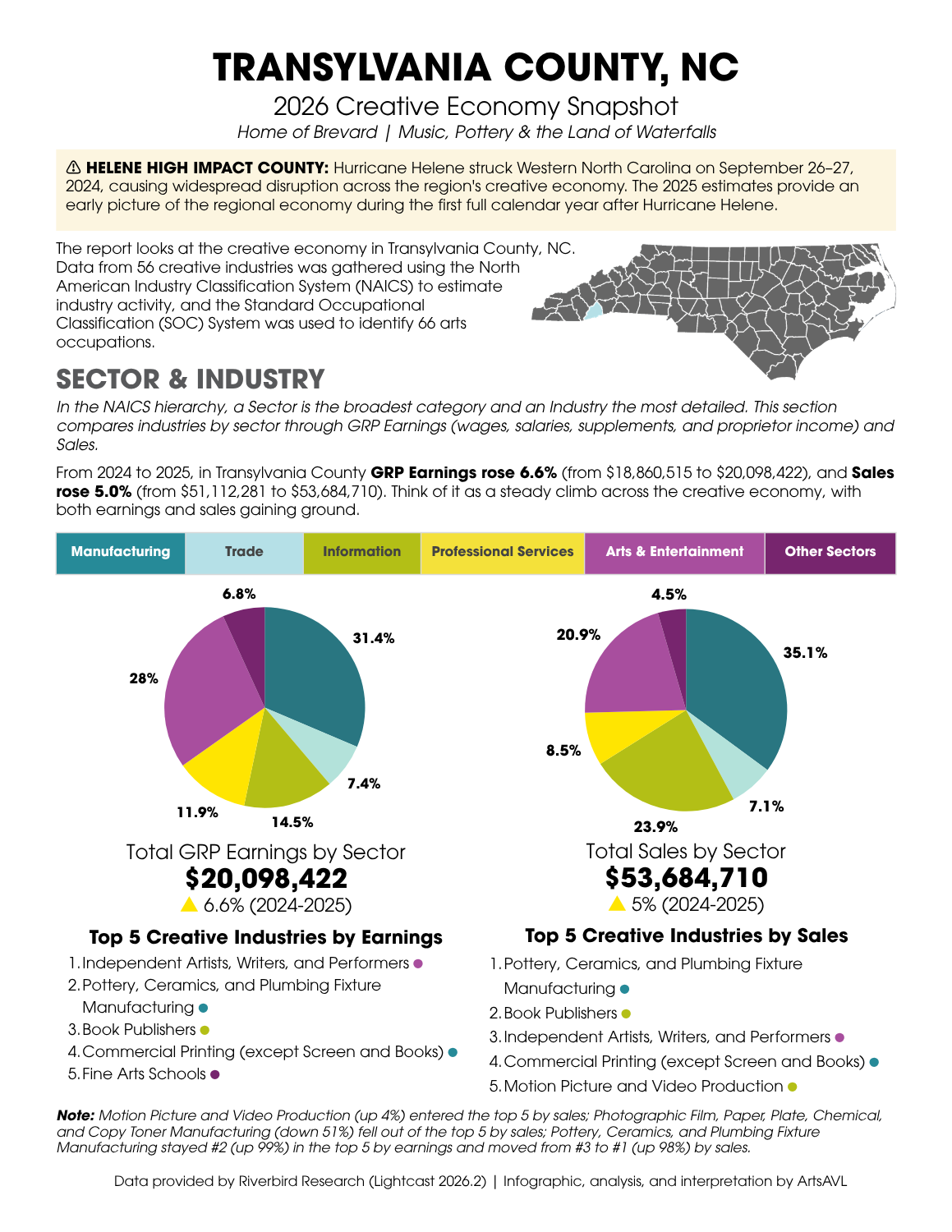
WATAUGA
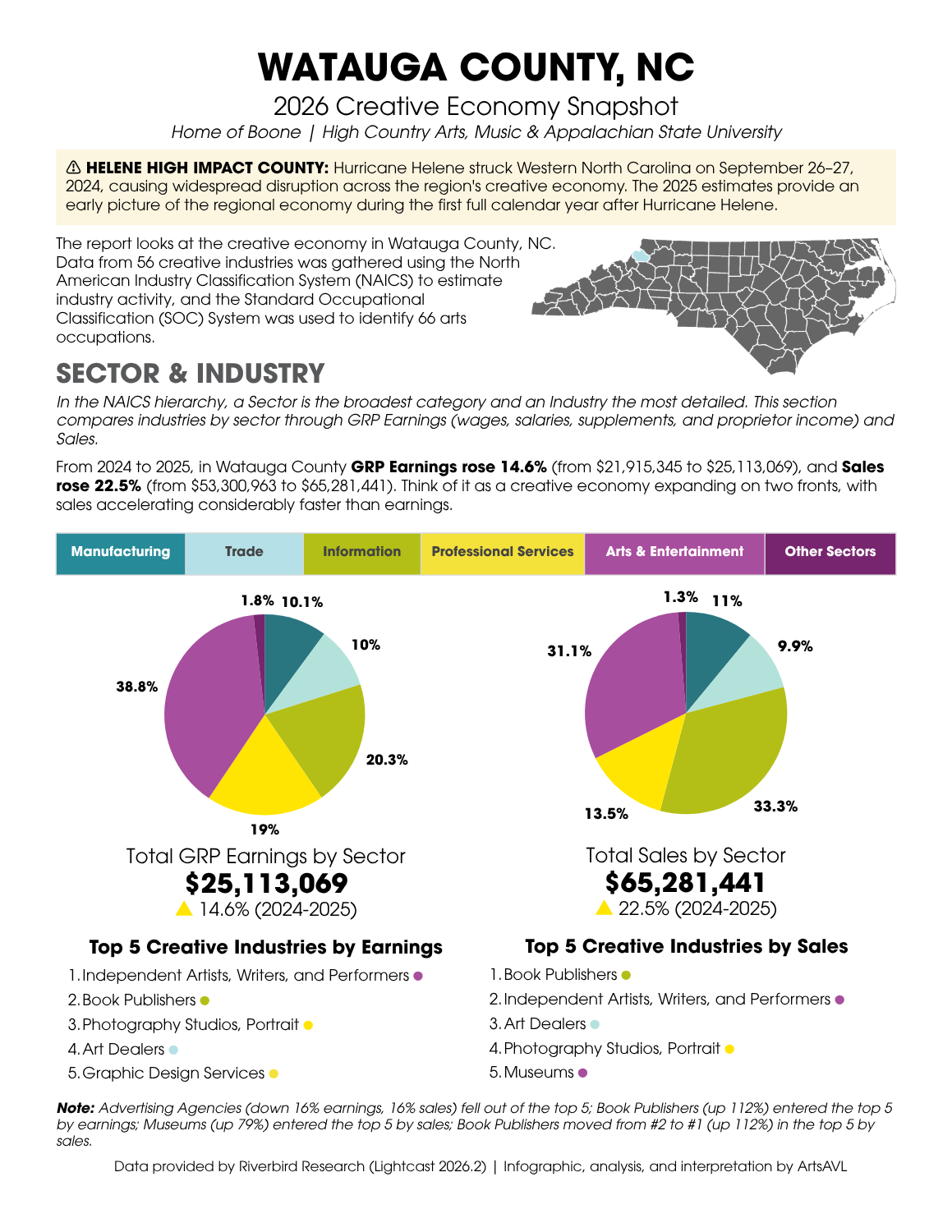
WILKES
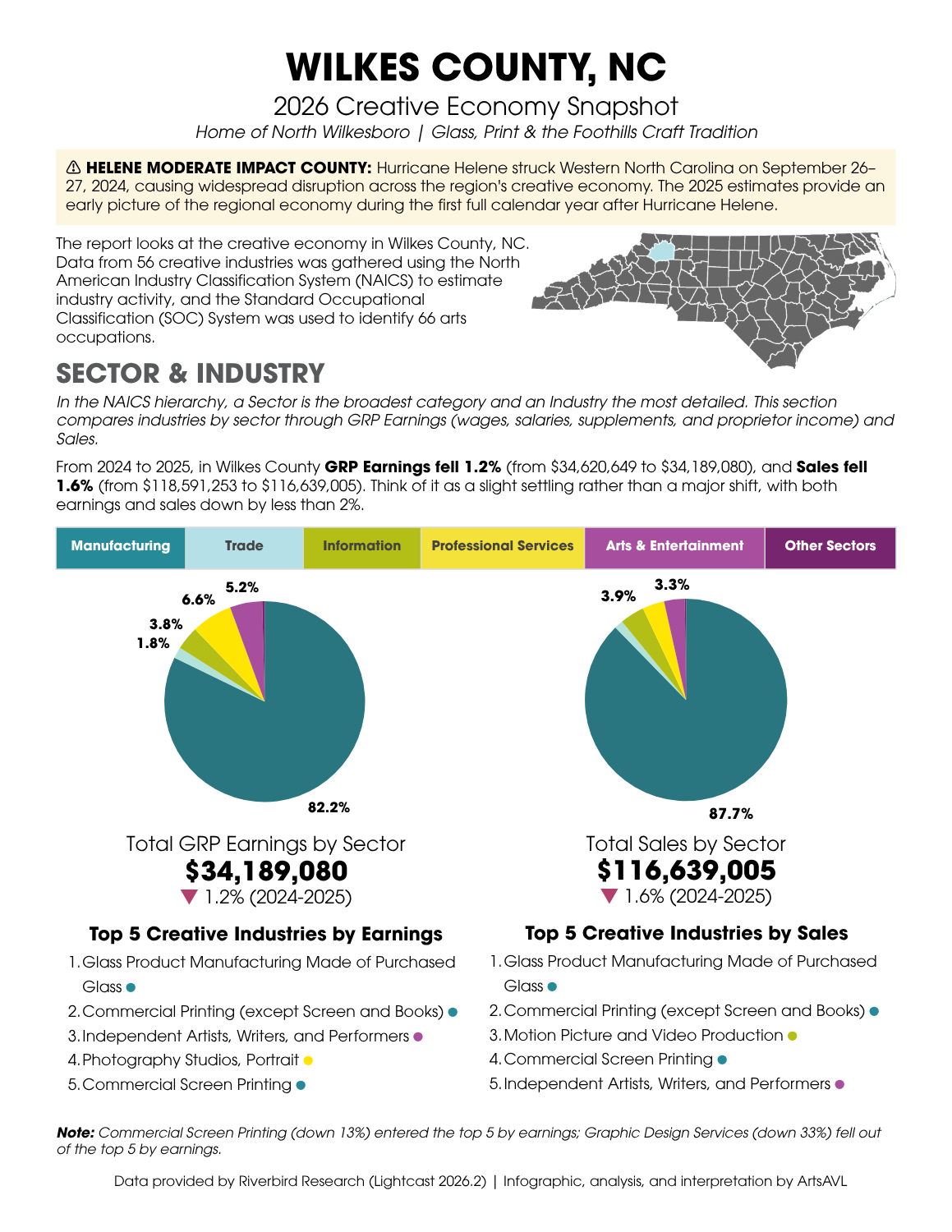
YANCEY
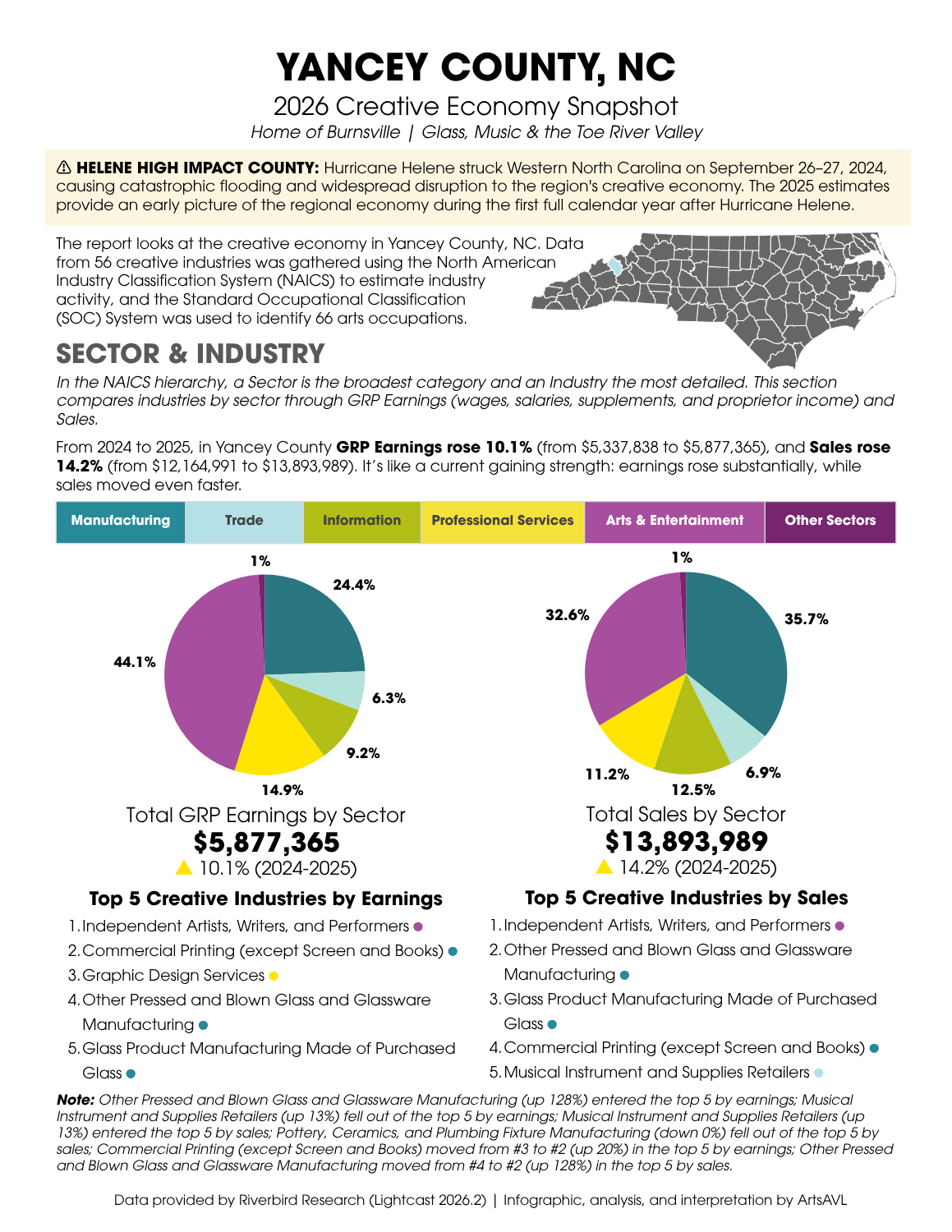
RELATED REPORTS
Buncombe County Arts Business Damage Assessment Reveals $14.8M in Losses After Hurricane Helene
Hurricane Helene caused $14.8M in losses for Buncombe arts businesses. This report reveals damage, needs, and recovery challenges across the creative sector.
Hurricane Helene Creative Sector Impact: 2024 WNC Creatives Needs Assessment Summary
WNC creatives report urgent post-Hurricane Helene needs—loss of studios, income, tools. Recovery hinges on targeted aid and sector-wide support.